Cannabis App Development
Beyond the Menu: The Dispensary Mobile App Benefits That Turn One-Time Buyers Into Loyal, High-Value Customers Who Keep Coming Back
Posted by: Digital Awesome
April 22, 2026
Most dispensaries don't have a traffic problem. They have a retention problem.
Customers find you. They walk in, they like what they see, and they buy something. Then they disappear — not because they had a bad experience, but because there was nothing pulling them back. No habit. No reason to think of your brand the next time they wanted to buy. No frictionless path from intent to purchase that made you the obvious choice over the three dispensaries between their house and yours.
That's the gap a native mobile app closes. And once you understand the dispensary app workflow — not as a digital ordering experience but as a retention engine running in the background of your business — the five benefits this guide covers stop looking like features and start looking like compounding revenue.
At Digital Awesome, we've built habit-forming cannabis mobile apps for 400+ operators across the United States and Canada. The pattern we see in every high-performing deployment is consistent: the dispensaries that grow fastest aren't outspending their competitors on acquisition. They're out-retaining them on mobile.
The Dispensary App Benefits That Drive Revenue — At a Glance
The benefits of a dispensary mobile app aren't isolated to one part of the business. They compound across purchase frequency, order size, customer retention, communication reach, and loyalty automation simultaneously — and each one reinforces the next.
Across 400+ cannabis operators, Digital Awesome-powered apps consistently deliver: a 60% increase in shopping frequency versus in-store and online channels, 48% higher average order values versus in-store purchases, 10.6x more weekly visits per user compared to other ordering channels, 97% user retention in the first 90 days after launch, and up to 97% push notification opt-in rates versus the 68% eCommerce average.
Every benefit below connects back to those numbers. Here's how each one works.
More Orders, More Often: How a Dispensary App Increases Purchase Frequency
The most important behavioral difference between a customer who uses your app and one who doesn't is habit. A customer who orders through a browser has to decide to visit your site. They have to think of you, open a tab, navigate, and commit. A customer with your app on their home screen gets a push notification on a Wednesday afternoon, taps it, and has reordered their regular in under two minutes — without making a single conscious decision to come back.
That's not convenience. That's a habit loop. And habit loops are what produce the 60% increase in purchase frequency that Digital Awesome-powered apps generate versus in-store and web channels consistently. The mechanism isn't the app itself — it's the sequence it enables: home screen placement keeps your brand present without requiring a search, the push notification creates a trigger, one-tap reordering eliminates every barrier between the trigger and the purchase, and the loyalty reward that follows makes the next cycle more likely than the last.
Customers who visit 10.6 times more per week through your app than through other channels aren't naturally more loyal. They're more loyal because your app made loyalty the default. Understanding what that frequency lift is worth in dollars for your specific dispensary size is the fastest way to make this concrete before you go any further.
Bigger Baskets: Why App Customers Spend 48% More Per Order
App users don't just come back more often. When they do, they spend more — 48% more per order than in-store customers, and 27% more than customers ordering through a website. The reason isn't that app users are inherently bigger spenders. It's that the environment the app creates produces different decision-making than the alternatives.
In-store purchasing is compressed. Customers are standing at a counter, there's a line forming, someone is waiting — and the entire experience nudges them toward the familiar and the fast. A website is better, but it's still cold. There's no memory of what they've bought before, no sense of what they might want next, and no loyalty layer nudging them toward adding one more item.
A well-built dispensary app changes all three. Saved preferences surface the products a customer already loves. Personalized recommendations introduce new products at exactly the right moment. Loyalty rewards and promo codes applied automatically at cart create a low-friction reason to increase the order. The result is an exploratory, unhurried shopping experience — and exploratory shoppers spend more. The specifics of how the platform is architected to produce those conditions are worth understanding before you assume all mobile ordering solutions deliver the same outcome. They don't.
Retention That Sticks: Why Dispensaries Need an App to Keep Customers Long-Term
This is where the real case for a dispensary mobile app lives — and where most operators are bleeding revenue they don't know they're losing.
A dispensary without a retention engine is running a perpetual acquisition loop. Every week, a percentage of past customers quietly moves on — to a competitor, to delivery, to inertia. Because there's no mechanism pulling them back, the only solution is to acquire new ones. That's expensive in any retail category. In cannabis, where paid digital advertising is heavily restricted, it's especially punishing.
The first purchase through a branded app is different from a first purchase anywhere else. When a customer creates an account, enables push notifications, and receives their first automatic loyalty reward after checkout, they've made a small but meaningful commitment to your brand. Every positive interaction after that — a relevant push notification, a fast reorder, a discount that feels earned — compounds that commitment into something that becomes difficult to walk away from. That compounding is what drives 97% user retention in the first 90 days across Digital Awesome-powered dispensaries.
The retention math is especially unforgiving in local cannabis retail, where the pool of reachable customers is finite and every lapsed buyer represents a real, recoverable revenue loss that compounds over time. Retaining a customer who already trusts you costs a fraction of winning a new one. A native mobile app is the only channel in cannabis retail that solves this systematically rather than reactively.
The Most Powerful Direct Channel in Cannabis: Push Notifications
Most cannabis operators can't run Google Ads. Meta advertising is so heavily restricted for cannabis brands that meaningful scale is nearly impossible. The traditional performance marketing playbook — paid search, social retargeting, display — is largely unavailable to dispensaries in ways it isn't for almost any other retail category.
This makes push notifications not just a feature of a dispensary mobile app. They are the most direct, most scalable, and most cost-effective customer communication channel available to cannabis retail, full stop.
Digital Awesome-powered apps achieve up to 97% push notification opt-in rates. The eCommerce industry average is 68%. The gap exists because a customer who downloads your branded app has already signaled intent and trust — they are far more willing to allow notifications from an app they chose to install than from a website they stumbled onto. The result is a communication channel with near-total reach into your existing customer base, at zero marginal cost per message.
What you do with that access determines everything. Push notifications that feel like broadcast promotions — generic, untimed, irrelevant — train customers to ignore them. Push notifications that feel personal — a restock alert for a strain a customer has bought three times, a loyalty milestone reward, a flash deal surfaced at the time of day the customer typically orders — build the kind of relationship that makes customers feel understood. That's the difference between a marketing channel and a retention engine.
A Loyalty Engine That Earns Its Keep Without Friction
Every dispensary in the country understands that loyalty drives repeat purchases. Most have tried to solve it — with punch cards, third-party apps, or points systems that require a separate login at checkout. The problem is never the intent. It's the friction. Any loyalty mechanic that asks the customer to do something extra will consistently underperform.
Digital Awesome apps include microcurrency — a branded, in-app rewards layer that credits points automatically when an order is fulfilled, with no extra action required from the customer. They buy. They earn. They return to redeem those points, buy more, and earn again. The loop is closed invisibly, and that invisibility is precisely what makes it work.
The habit science behind this is well established: reward timing matters. A loyalty reward that arrives automatically within seconds of a fulfilled order reinforces the purchasing behavior at the exact neurological moment when reinforcement is most effective. A punch card that requires manual stamping or a login to a separate loyalty app breaks the loop entirely — because by the time the customer gets home, the moment is gone. Customers who earn and redeem in-app rewards consistently show higher order frequency, larger basket sizes, and stronger 90-day retention than those who don't. The loop is the product.
What Dispensaries Without a Native App Are Actually Losing
A dispensary without a native mobile app isn't standing still. It's falling behind — and the gap is measurable.
According to Headset.io, which tracks over a billion dollars in cannabis transactions monthly, online ordering now accounts for 25–30% of dispensary revenue across U.S. markets. Operators without a strong mobile ordering experience are not missing a convenience feature. They are missing a material share of their market, and the operators who are capturing it are doing so through channels that build long-term loyalty rather than one-time transactions.
The deeper loss is structural. Dispensaries without a native app are routing their mobile customers through third-party marketplaces. Those platforms drive traffic — but the customer relationship belongs to the platform, not the dispensary. The data is theirs. The communication channel is theirs. Every customer who orders through a third-party listing is a customer you paid to acquire and then handed off. You can't send them a push notification. You can't reward their next order through your loyalty program. You can't personalize their next visit. You own the transaction and nothing else.
A native app changes the ownership model entirely. A customer who downloads your app, creates an account, and orders through it belongs to your ecosystem — fully and permanently. Their preferences, their history, their communication channel, and their loyalty are all yours to build on. That's a fundamentally different business than the one you run without it. A sound cannabis marketing foundation — SEO, email, local presence — is what brings customers to your door. The app is what keeps them there.
Cannabis App Benefits vs. a Website vs. a Third-Party Marketplace
The most common objection from operators who are evaluating a native app is some version of: "We already have an online menu. Why do we need an app on top of that?"
It's a fair question and the answer matters. A website is discoverable. A customer who searches for a dispensary near them might find you. That's where the website's strategic value ends — it doesn't live on their home screen, it can't send them a push notification, it has no loyalty integration, and it cannot build a habit. It can bring customers in. It cannot keep them.
A third-party marketplace has traffic, but the customer relationship belongs to the platform. You are renting access to an audience that will never be yours, on terms that can change at any time, in an environment where your competition is one scroll away.
A native app is the only channel in cannabis retail where you own the relationship entirely. The customer data, the communication access, the loyalty program, the reorder flow — all of it sits inside your ecosystem. That's not an incremental improvement over a website or a marketplace listing. It's a structural advantage that compounds every time a customer opens the app instead of searching for an alternative.
How Digital Awesome Delivers These Benefits for 400+ Operators
The dispensary app benefits described throughout this guide don't emerge from a white-label template or a generic e-commerce solution. They come from purpose-built native iOS and Android apps that integrate with the dispensary's existing tech stack from day one.
Digital Awesome connects to the POS systems operators are already running — Dutchie, Treez, Jane, Flowhub, and Meadow. Loyalty platforms including Alpine IQ and Springbig sync directly into the app, so points credit automatically without any additional workflow. Delivery is managed through Onfleet. Cannabis-compliant payments run through Aeropay, Canpay, POSaBIT, and TreezPay. The integrations are maintained through a network of cannabis technology and agency partners who connect directly into the platform — so operators aren't building from scratch and aren't locked into a single vendor stack as their business evolves.
Apps go live in as few as 60 days. Clients including Cookies, Planet 13, Glass House Brands, Sol Flower, and Exclusive are already running on the platform — and generating the order frequency, basket size, and retention outcomes this guide has documented in detail.
TL;DR Quick Answers
What are the benefits of a dispensary mobile app?
The top dispensary app benefits are more frequent purchases (60% more versus in-store and web), higher average order values (48% more versus in-store), strong customer retention (97% in the first 90 days), direct push notification reach at up to 97% opt-in, and an automated loyalty engine that rewards customers without any friction. All five compound on each other in a habit loop that grows more valuable the longer a customer stays in it.
Why do dispensaries need an app?
Because it's the only channel in cannabis retail where the operator owns the customer relationship entirely. Websites need the customer to seek you out. Marketplaces hand the relationship to a platform. A native app puts your brand on the home screen, your offers in the customer's pocket, and your loyalty program running automatically — building the habits that produce compounding, long-term revenue.
What makes cannabis app benefits different from a loyalty card or email newsletter?
Immediacy and frictionlessness. A loyalty card requires the customer to remember it. An email requires the customer to open it. A native app push notification arrives on the lock screen, personalized to the customer's behavior, with one tap to reorder. The engagement differential is not marginal — it's the reason Digital Awesome-powered apps achieve 97% push opt-in versus the 68% eCommerce average. The channel is fundamentally different, not just incrementally better.
How fast can a dispensary go live with a Digital Awesome app?
In as few as 60 days. Digital Awesome integrates with the POS, loyalty, payment, and delivery tools an operator is already running — so there's no replacing existing infrastructure. The result is a native iOS and Android app with every integration, compliance layer, and retention mechanic built in, live and generating revenue within the same quarter the decision is made.
Top Takeaways
A dispensary mobile app is a retention engine — not a digital menu. The distinction defines everything: what features matter, what metrics you track, and how you measure success. An app that exists to display products is a convenience. An app built to form habits is a business asset.
The five dispensary app benefits compound on each other. More frequent purchases lead to higher lifetime value. Higher average order values amplify the revenue impact of every frequency gain. Strong retention means each new customer you acquire is worth dramatically more over time. Push notification reach means you can activate that retention loop on demand. Loyalty automation means the loop runs without requiring any ongoing effort from the operator.
Owning the customer relationship is the strategic core of why dispensaries need an app. Websites bring customers in. Marketplaces borrow customers from a platform that owns them. A native app is the only channel in cannabis retail where the data, the communication access, and the loyalty relationship belong entirely to the dispensary.
Push notifications are the most powerful direct marketing channel available to cannabis operators — and most dispensaries are either not using them or underusing them. A 97% opt-in rate versus the 68% eCommerce average is a structural advantage that cannot be replicated through any other channel accessible to cannabis brands at scale.
Online ordering now accounts for 25–30% of dispensary revenue. This is not a projection — it is the current state of the market, measured across billions of dollars in real transactions. Operators without a native mobile experience are not neutral to this trend. They are ceding ground to the operators who built first.
The window for first-mover advantage on mobile is still open in most markets — but it is closing. The dispensaries building the deepest customer relationships right now through mobile will be the hardest to compete against in three years. The time to build is before that gap becomes unrecoverable.
"Here's what 400 dispensaries have taught us: the operators who grow fastest aren't outspending their competitors on customer acquisition. They're out-retaining them on mobile. The math is simple when you see it clearly. A customer who orders through your branded app twice a month, at 48% higher average order values, over a 90-day window where 97% of them stay — that's not a channel. That's a business model. What most operators don't realize until they're inside it is that the app isn't the product. The habit is the product. The app is just what makes the habit possible — the home screen presence, the push notification at the right moment, the one-tap reorder, the loyalty point that appears before they've even thought about coming back. We didn't invent habit-forming software. We just figured out how to build it specifically for cannabis retail, where the advertising restrictions mean that owning the customer relationship isn't a competitive advantage — it's the only sustainable path to growth. The window to build that advantage before your local competitors do is still open. Not permanently, but right now."
— Digital Awesome Leading Cannabis Mobile App Developer
7 Essential Resources for Cannabis Operators
Understanding the full strategic value of a dispensary mobile app means understanding the regulatory environment, the consumer landscape, and the policy trajectory it operates within. These seven verified resources give dispensary operators the context that informs every smart mobile decision.
1. CDC — Cannabis Facts and Stats The Centers for Disease Control and Prevention maintains a comprehensive national data hub on cannabis use prevalence, demographic trends, and behavioral patterns — the baseline consumer picture every dispensary marketing and mobile strategy should be built on. 🔗 https://www.cdc.gov/cannabis/data-research/facts-stats/index.html
2. CDC — State Medical Cannabis Laws An up-to-date overview of which states have enacted medical and adult-use cannabis programs, how those programs differ, and what products are permitted — directly relevant to what any state-compliant dispensary app can offer your customers. 🔗 https://www.cdc.gov/cannabis/about/state-medical-cannabis-laws.html
3. SAMHSA — Marijuana Data and Research The Substance Abuse and Mental Health Services Administration publishes national data on cannabis use prevalence and treatment patterns — essential context for understanding the scale and behavioral profile of the consumer base a mobile app is designed to retain. 🔗 https://www.samhsa.gov/data/taxonomy/term/435
4. NIDA — Scope of Marijuana Use in the United States The National Institute on Drug Abuse provides research-backed longitudinal data on cannabis consumption in the U.S. — useful for operators who want to understand how usage behavior is evolving across age groups and markets as they build their mobile retention strategy. 🔗 https://nida.nih.gov/research-topics/cannabis-marijuana
5. Congress.gov — The Federal Status of Marijuana and the Policy Gap with States A Congressional Research Service brief mapping the ongoing divergence between federal cannabis law and state legalization frameworks — essential reading for any operator building a long-term digital investment in a market where the regulatory floor is still shifting. 🔗 https://www.congress.gov/crs-product/IF12270
6. Data.gov — Cannabis Datasets The U.S. Government's open data platform includes multiple cannabis-related datasets covering retail sales, pricing, and product market data from states with legal markets — a valuable source for operators building data-driven mobile strategies grounded in real market dynamics. 🔗 https://catalog.data.gov/dataset?tags=marijuana
7. NIH/PMC — U.S. State Recreational and Medical Cannabis Delivery Laws, 2024 A peer-reviewed legal epidemiology study published via the National Institutes of Health that maps which states now permit direct cannabis delivery, the applicable licensing requirements, and age verification obligations — directly relevant to how a compliant cannabis delivery app must be built and operated in your state. 🔗 https://pmc.ncbi.nlm.nih.gov/articles/PMC11715591/
3 Statistics That Define Why the Mobile Opportunity Is Now
Statistic 1 — Online Ordering Already Drives 25–30% of Dispensary Revenue
Headset.io, which directly measures over $1 billion in cannabis transactions monthly across more than 3,500 retail partners in the United States and Canada, reports that online ordering now accounts for between 25% and 30% of total dispensary sales revenue — and the share continues to grow quarter over quarter. Operators without a strong mobile ordering presence are not missing a convenience feature. They are absent from a channel that accounts for nearly a third of the market's revenue, and the operators filling that gap are doing so through branded, loyalty-integrated mobile experiences — not third-party listings. 🔗 Source: Headset.io — Cannabis Retail Intelligence
Statistic 2 — 64.2 Million Americans Used Cannabis in the Past Year
According to data cited by the Congressional Research Service, approximately 64.2 million individuals aged 12 or older reported using cannabis in the past year as of 2024, with 44.3 million reporting use in the past month. As a proportion of the U.S. population, cannabis use has grown from 6.1% in 2008 to 15.4% in 2024 — a consumer base that is large, still expanding, and increasingly accustomed to mobile-first purchasing behavior across every category of retail, cannabis included. 🔗 Source: Congress.gov — Federal Status of Marijuana
Statistic 3 — 14 States Now Authorize Recreational Cannabis Delivery
A 2024 legal review published via the National Institutes of Health found that 14 states have authorized the direct delivery of recreational cannabis to adults, and 26 states plus the District of Columbia permit the direct delivery of medical cannabis. This rapid policy expansion is a primary driver behind the strategic urgency around cannabis delivery apps — operators in delivery-legal markets who don't have a native app are not just leaving convenience on the table. They are leaving an entire fulfillment channel unmonetized. 🔗 Source: PMC/NIH — U.S. State Cannabis Delivery Laws 2024
Our Take
The dispensary app market is no longer in its experimental phase. The operators who treated mobile as a priority two or three years ago have spent that time building something their competitors are still trying to catch up to: a customer base that has formed a habit around their brand. Habits are not broken easily. A customer who reorders from your app twice a month, earns loyalty points automatically, and receives push notifications that feel relevant — that customer is not browsing Weedmaps to compare prices. They already know where they're buying.
What we've learned building apps for 400+ cannabis operators is that the dispensaries generating the most durable revenue growth share one characteristic: they stopped thinking about mobile as a channel and started treating it as the relationship layer of their business. The app is how they talk to their customers. The app is how their customers think of them first. The app is where the loyalty compounds and the habit deepens and the lifetime value climbs to a level that acquisition spending alone could never achieve.
The honest take on timing: the competitive window in most markets is still open. In many local and regional markets, the majority of dispensaries still don't have a native app — which means the first operator to build genuine mobile habits with their customer base will be extremely difficult to displace. That window does not stay open indefinitely. Cannabis retail is consolidating. The brands that survive consolidation will be the ones with the deepest customer relationships — and in 2026, the deepest customer relationships are built on mobile.
If you're an operator reading this and you don't yet have a native app, the question isn't whether you need one. The question is whether you want to build your mobile advantage before your competitors do, or after.
What’s Next?
For dispensary operators:
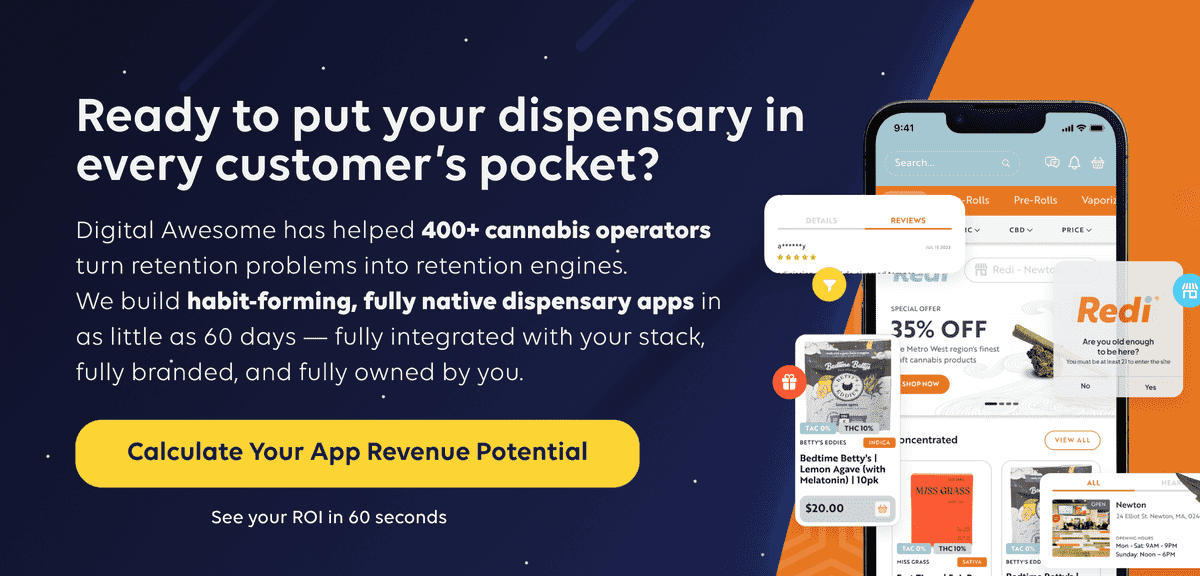
The fastest way to understand the revenue impact of a Digital Awesome-powered app for your specific dispensary is to run the numbers before you book a call. The ROI calculator takes about two minutes and gives you a concrete revenue estimate based on your current performance metrics.
When you're ready to see the platform in action — the POS integrations, the loyalty mechanics, the push notification engine, the checkout flow — see it running on a dispensary built like yours. No sales pitch. No commitment. Just a real look at what the platform delivers.
For agency and integration partners:
If you're a cannabis marketing agency, POS provider, or loyalty platform working with dispensary operators, the partner program is built for you.
Frequently Asked Questions
What are the main benefits of a dispensary mobile app?
The core cannabis app benefits are increased purchase frequency, higher average order values, stronger long-term customer retention, a direct push notification channel with near-total opt-in reach, and an automated loyalty engine that rewards customers without friction. Across Digital Awesome's 400+ operator client base, these benefits consistently produce a 60% lift in shopping frequency, 48% higher average order values, and 97% user retention in the first 90 days after launch.
Why do dispensaries need an app instead of just a website?
A website requires the customer to seek you out. A native app lives on their home screen, sends behavior-triggered push notifications, saves their preferences, and rewards their loyalty automatically — producing 10.6x more weekly visits per user than any other ordering channel. A website can drive discovery. Only a native app builds the habits that turn one-time buyers into long-term regulars.
How much do dispensary app benefits impact revenue?
Meaningfully and immediately. Digital Awesome clients see 48% higher average order values through the app versus in-store and up to 30% of total store revenue processing through the app within 90 days of launch. For a dispensary generating $500,000 per month, a 30% app adoption rate represents $150,000 in monthly revenue flowing through a channel the dispensary owns and controls entirely.
What cannabis app benefits do customers actually experience?
Customers notice the speed of reordering familiar products, the relevance of push notifications that don't feel like spam, loyalty points that appear automatically without any extra steps, and a checkout experience that is faster and less pressured than standing at a counter. What they don't consciously notice — but directly benefit from — is the personalization running in the background, surfacing products aligned with their history every time they open the app.
How quickly can a dispensary expect to see results after launch?
Digital Awesome apps go live in as few as 60 days. Most clients see measurable adoption and engagement within the first 30 days of launch, particularly when in-store and email promotion of the app download is active at launch. The Amplify Ohio deployment — 30% app adoption, 48% higher order values, and a sub-5% churn rate — was achieved within 90 days of go-live and represents what a well-executed launch looks like in practice.
Ready to See What These Benefits Look Like for Your Dispensary?
Several operators across the United States and Canada are already running on Digital Awesome's platform — generating the frequency lifts, order value increases, and retention rates this guide has documented from start to finish. The data exists because the platform works. And the platform works because it was built specifically for cannabis retail, with every integration, compliance layer, and habit-forming mechanic designed around how cannabis consumers actually behave.