Cannabis App Development
Types of Cannabis Mobile Apps Your Dispensary Business Needs — From a High-Converting Dispensary Ecommerce App to a Rewarding Cannabis Loyalty App and Weed Delivery App
Posted by: Digital Awesome
April 28, 2026
The cannabis retail market isn't getting easier. There are now nearly 15,000 licensed dispensaries across the United States, and customers have never had more options for where to spend their dollar. Meanwhile, the paid advertising restrictions that have defined this industry for years haven't disappeared — and even as how cannabis rescheduling is reshaping marketing and advertising compliance continues to evolve, the consensus is clear: owned channels still matter most. You can't buy your way to retention on Meta. You can't Google Ad your way to loyalty. The dispensaries pulling ahead are the ones building direct, habitual relationships with customers — and the most effective tool for doing that is a mobile app.
But here's where most conversations stop too soon. Most dispensary owners ask, "Do I need an app?" The better question is: "Do I understand the different types of cannabis mobile apps — and what each one is actually built to do?"
There's a meaningful difference between an app that helps customers shop and an app that makes them come back. And there's another difference entirely between an app that handles ecommerce and one that puts your delivery channel in a customer's pocket. Understanding how these app types work — and why the best dispensaries run all of them inside a single platform — is what separates a mobile strategy that drives revenue from one that just checks a box.
What Are the Different Types of Cannabis Mobile Apps?
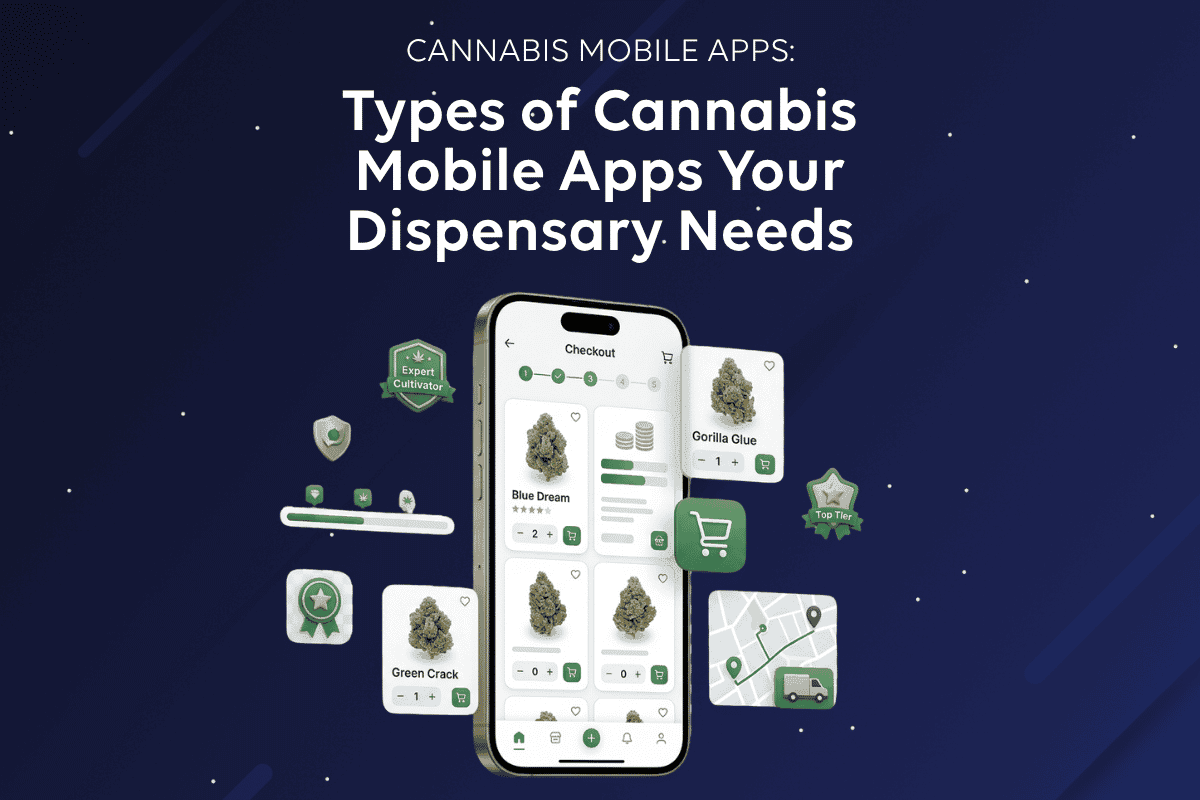
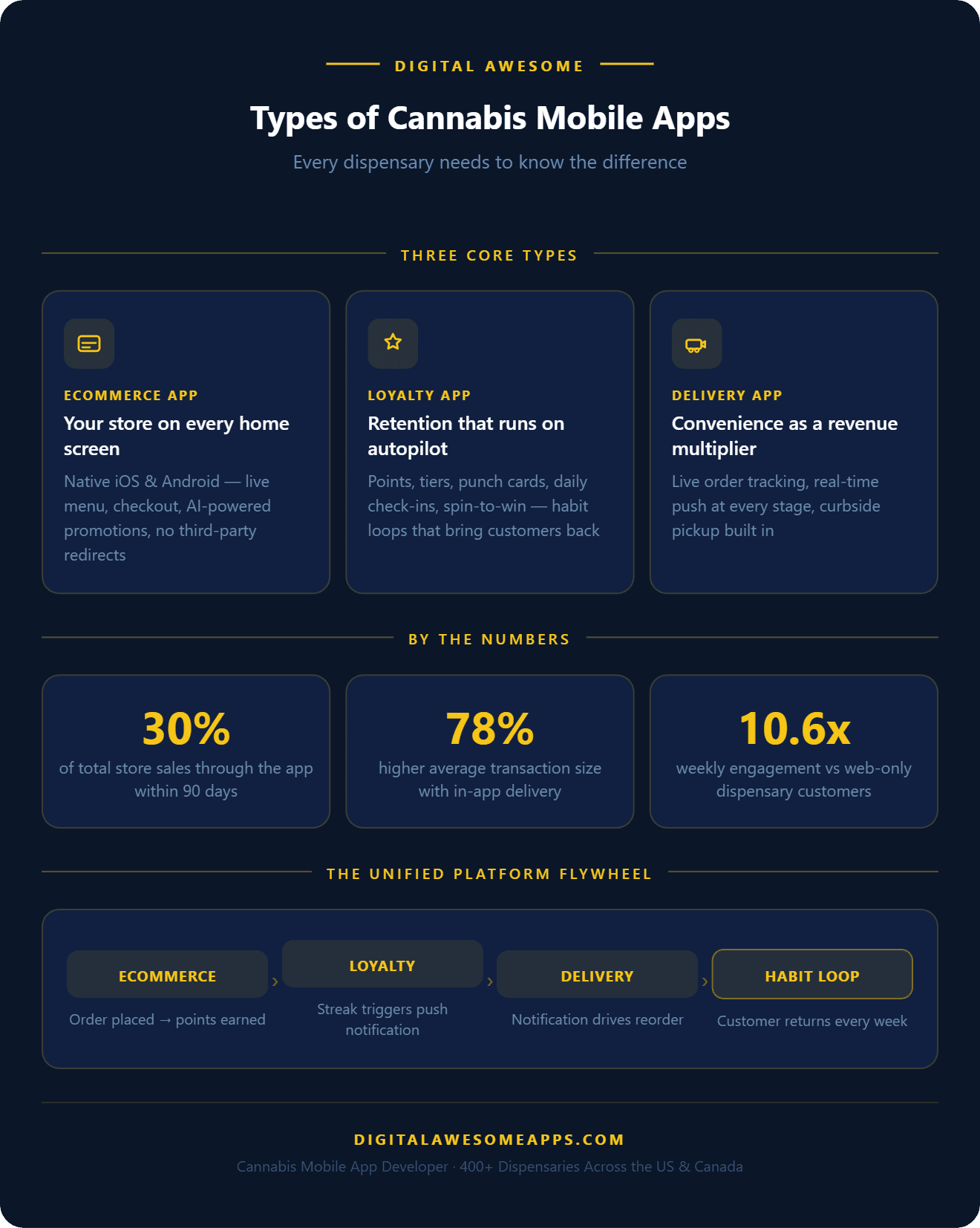
Modern cannabis apps are not one-size-fits-all. They're built around distinct functional layers, each designed to solve a specific problem in the customer journey. The three core types every dispensary owner should understand are the dispensary ecommerce app, the cannabis loyalty app, and the weed delivery app. Most powerful when unified, each plays a different role in moving a customer from first-time visitor to loyal regular.
1. The Dispensary Ecommerce App: Your Store in Every Pocket
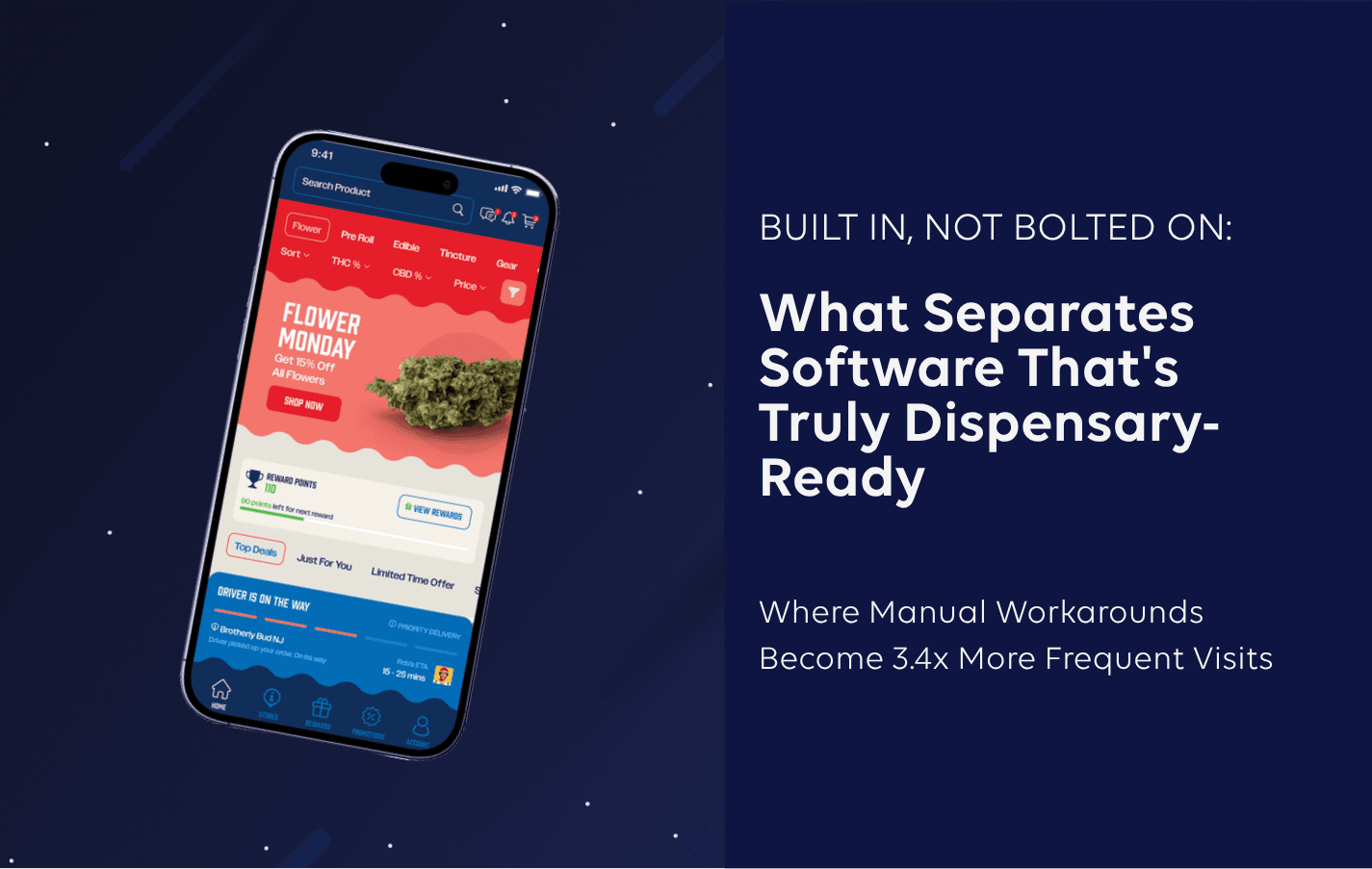
A dispensary ecommerce app is a native iOS and Android application that allows customers to browse your live menu, place orders, and complete checkout — all without leaving your brand's environment or getting bounced to a third-party marketplace. It's not a website with a mobile skin. It's a purpose-built shopping experience that lives on the customer's home screen.
This distinction matters more than most operators realize. When your store lives on a customer's phone, you're not waiting for traffic — you're generating it. Push notifications, personalized banners, and real-time promotions can activate customers the moment conditions are right, whether that's a flash deal on a slow Tuesday or a reorder reminder for a product they've bought three times before.
The features that separate a high-converting dispensary ecommerce app from an average one aren't cosmetic. Real-time menu syncing means customers never see out-of-stock products that erode trust. Native checkout with saved preferences means fewer abandoned carts. An AI-powered promotions engine means the right offer reaches the right customer without your team manually sorting segments. And full integration flexibility means your app adapts when your POS or menu provider changes — not the other way around.
Operators who want to see what a full ecommerce feature set looks like in practice will find a comprehensive breakdown of dispensary app features worth exploring — it covers everything from promo banners and native in-app shopping to advanced audience segmentation and geofencing.
2. The Cannabis Loyalty App: Retention That Runs on Autopilot
A cannabis loyalty app is the retention engine of your mobile strategy. At its core, it's a system of rewards, engagement mechanics, and behavioral triggers — all designed to make returning to your dispensary feel good enough that it becomes a habit.
Basic points programs are table stakes now. Customers have seen them everywhere, and a flat "earn one point per dollar" structure isn't enough to create the kind of emotional connection that drives weekly visits. The cannabis loyalty apps that are genuinely moving retention metrics are the ones built around gamification — tiered achievement systems that give customers a sense of progression, digital punch cards that reward specific behaviors, daily check-in streaks, spin-to-win features, and sweepstakes that reward engagement beyond the transaction.
Think about how the apps customers already love — fitness trackers, coffee chains, gaming platforms — use progress and reward to build daily habits. A well-designed cannabis loyalty app borrows from the same psychology. When customers are working toward a badge, leveling up a tier, or maintaining a streak, they're not just buying cannabis. They're invested in the relationship with your brand.
The business case is straightforward. Discounting gets traffic. Loyalty gets customers. And in a market where price compression is real and margins are tightening, the dispensaries that win long-term are the ones building relationships that don't depend on who has the lowest price this week.
3. The Weed Delivery App: Convenience as a Revenue Multiplier
A weed delivery app — more precisely, a delivery module integrated into a dispensary's mobile experience — allows customers to place delivery orders, track their status in real time, and receive their product without visiting the store. For dispensaries with a delivery license, this isn't just a convenience feature. It's one of the highest-impact revenue levers available.
The numbers are striking: dispensaries with in-app delivery integrations see average transaction sizes increase by up to 78% compared to in-store orders. The reason is behavioral. When customers order from home, they browse more deliberately, consider additional products, and aren't constrained by the social pressure of a line behind them. The app environment encourages discovery in a way the store counter simply doesn't.
What makes the difference between a delivery experience that delights and one that frustrates is transparency and speed. Live order tracking that shows customers exactly where their order is — prepared, packaged, dispatched, delivered — eliminates the anxiety of the unknown. Real-time push notifications at every stage keep customers informed and give your brand repeated touchpoints in a single transaction. Curbside pickup, offered as a complement, captures the customers who want convenience without the wait for full delivery.
The key implementation insight: delivery works best when it's a seamlessly integrated module inside your existing app, not a separate product that splits your customer's attention across platforms.
Why the Best Dispensaries Run All Three Inside One Platform
Each app type solves a different problem — but their real power is compounding. When a customer places an ecommerce order, they earn loyalty points. Those loyalty points trigger a push notification the next time they're in a delivery zone. That notification brings them back for a reorder. That reorder feeds their achievement streak. The streak keeps them opening the app every day.
This is the flywheel that top-performing dispensaries have built — and it only works when all three types run inside a single, unified platform rather than three disconnected tools that don't share data. Operators who have built this unified experience are already reporting that up to 30% of their total store sales now flow through their app. Not their website. Not a third-party ordering platform. Their app.
For dispensary owners curious about what that revenue impact could look like for their specific store, the dispensary app ROI calculator gives a quick, personalized estimate based on current sales volume.
TL;DR Quick Answers
What Are the Types of Cannabis Mobile Apps?
There are three types of cannabis mobile apps dispensaries rely on to drive sales, retention, and convenience: the dispensary ecommerce app, the cannabis loyalty app, and the weed delivery app. Each one solves a different problem — and together inside a single unified platform, they create the kind of mobile experience that turns occasional shoppers into weekly regulars.
How the three types of cannabis mobile apps work together, type by type:
- A dispensary ecommerce app puts a live, POS-synced storefront on the customer's home screen for seamless browsing and checkout
- A cannabis loyalty app rewards every purchase and interaction with points, achievements, and gamified mechanics that make returning feel worthwhile
- A weed delivery app brings the dispensary to the customer's door with real-time tracking and automated order status updates
- Each app type feeds the next — an ecommerce order earns loyalty points, which trigger a push notification, which drives the next delivery
- Operators manage menus, campaigns, loyalty performance, and delivery integrations from one central dashboard
- Customers experience one continuous branded journey from first tap to fulfilled order, regardless of which app type they're using
What operators see when all three types run on the right platform:
- Up to 30% of total store revenue flowing through the app within the first 90 days
- Higher customer visit frequency compared to web-only or in-store-only shoppers
- Significant lift in average order value driven by the delivery and ecommerce experience
- Measurable improvement in retention rates versus pre-app benchmarks
Why it actually works: The real advantage isn't any single app type — it's the shared data layer underneath them. When ecommerce, loyalty, and delivery talk to each other, every customer interaction makes the next one smarter.
Built for this industry: Digital Awesome has spent over a decade building exclusively for cannabis retail — which means the integrations, compliance requirements, and customer behavior patterns that trip up general app developers are already solved before your project begins.
Key Takeaways
- There are three core types of cannabis mobile apps every serious dispensary should understand: the dispensary ecommerce app, the cannabis loyalty app, and the weed delivery app — each built for a different stage of the customer journey.
- A dispensary ecommerce app puts your live menu, checkout, and personalized promotions directly on the customer's home screen — and removes the friction that causes mobile shoppers to abandon before they buy.
- A cannabis loyalty app uses gamified mechanics — tiered achievements, punch cards, daily check-ins, spin-to-win — to build the kind of habitual engagement that makes customers return without needing another discount.
- A weed delivery app integrated natively into your platform increases average transaction sizes by up to 78% — because customers who order from home shop longer, browse wider, and add more to their cart.
- The dispensaries seeing the biggest results don't run three separate tools. They run all three app types inside a single, unified platform where ecommerce, loyalty, and delivery share data and feed each other.
- Over 80% of cannabis ecommerce traffic comes from mobile — which means your app isn't a secondary channel. For a growing share of your customers, it's the only channel that matters.
- 86% of cannabis shoppers say they'll be loyal to a dispensary that personalizes their experience — a loyalty app that learns customer preferences and surfaces relevant offers is the single most direct way to deliver that.
- Top-performing dispensaries are already generating 50% or more of total revenue through digital channels. The operators building that capability now are creating a compounding advantage that gets harder to close over time.
"The dispensaries that are winning right now aren't the ones with the fanciest store or the biggest marketing budget. They're the ones that figured out how to turn their app into a daily habit for their customers — not just a shopping tool. We've seen operators go from 5% of sales through their app to over 30% in less than a year, and the ones who get there fastest are the ones who treat ecommerce, loyalty, and delivery as a single connected system, not separate features to bolt on later. The app is the channel. Everything else feeds it."
— Digital Awesome Team, Leading Cannabis Mobile App Developer
7 Essential Resources on Types of Cannabis Mobile Apps
Every dispensary operator building or upgrading a mobile strategy needs to understand the regulatory framework that governs how apps can operate — what delivery rules apply, what loyalty advertising is permitted, and what compliance requirements come with digital retail. These are the seven most important resources to have open before making any mobile app decisions.
1. Know Exactly What a Cannabis Retail License Permits Your App to Do
California Department of Cannabis Control — Retail Licensing Requirements The official state authority on what licensed cannabis retailers can and cannot do in digital sales, including delivery operations, age verification requirements, and operating hours that directly govern how a dispensary ecommerce app and weed delivery app must function. cannabis.ca.gov/licensees/retail
2. The Compliance Rulebook for Every Weed Delivery App in California
California DCC — Record-Keeping & Track-and-Trace Requirements for Delivery A detailed regulatory guide covering exactly how delivery inventory must be tracked, what information a weed delivery app must capture in real time, and how delivery ledgers must be maintained in the California Cannabis Track and Trace system. cannabis.ca.gov — Delivery Track-and-Trace Requirements
3. The Full Regulatory Framework Your Dispensary App Must Be Built Around
California DCC — Official Cannabis Regulations (Updated January 2026) The complete California Code of Regulations governing commercial cannabis — the authoritative source for understanding every compliance requirement that shapes how a dispensary ecommerce app, loyalty program, and delivery integration must be structured to stay legally operational. cannabis.ca.gov/cannabis-laws/dcc-regulations
4. What New York's Retail Compliance Rules Mean for Your App Strategy
New York State Office of Cannabis Management — Retail Regulations & Compliance Overview A government-issued compliance training document covering New York's dispensary retail rules — including digital app pricing disclosure requirements, age verification at point of delivery, and what customer data dispensaries may and may not collect through a mobile platform. cannabis.ny.gov — Retail Regulations & Compliance Overview (PDF)
5. Understanding Delivery Licensing Before You Build a Weed Delivery App
DC Alcoholic Beverage and Cannabis Administration — Retailer License The official DC government resource outlining what a cannabis retail license permits for delivery operations — including which endorsements dispensaries must hold to operate a weed delivery app and what restrictions apply to delivery hours and service areas. abca.dc.gov/page/retailer-license
6. The Law Behind Cannabis Loyalty App Advertising Is Finally Changing
Massachusetts Legislature — An Act Modernizing the Commonwealth's Cannabis Laws A government press release on new Massachusetts legislation that — for the first time — gives the Cannabis Control Commission the authority to permit dispensaries to advertise loyalty programs via opt-in email and in-store, directly affecting how cannabis loyalty apps can be marketed to customers. malegislature.gov — Cannabis Modernization Act Highlights
7. What Peer-Reviewed Research Says About How Cannabis Mobile Apps Actually Perform
National Institutes of Health (NIH/PMC) — Cannabis Mobile Apps: A Content Analysis A peer-reviewed study published in NIH's National Library of Medicine analyzing the top cannabis apps across the Apple App Store and Google Play — covering content types, feature usage, and how dispensary apps compare to other cannabis app categories in terms of engagement and functionality. pmc.ncbi.nlm.nih.gov — Cannabis Mobile Apps: A Content Analysis
3 Statistics Every Dispensary Owner Should Know Before Choosing a Mobile App
Statistic 1 — Online Ordering Now Accounts for 25–30% of Total Dispensary Revenue
Headset.io pulls real transaction data directly from POS systems at more than 3,500 cannabis retailers across the US and Canada, making it the most reliable measure of where dispensary revenue actually comes from. Their data shows that digital ordering has moved well past the "nice to have" stage — it now represents between a quarter and a third of what dispensaries earn, with the highest-performing stores pushing past 50% of total revenue through their own digital channels. The dispensary ecommerce app is no longer a feature sitting alongside a business. For a growing number of operators, it is the business. 🔗 Source: Headset.io — Cannabis E-Commerce + POS Market Intelligence
Statistic 2 — 64.2 Million Americans Reported Using Cannabis in the Past Year
The Congressional Research Service, a nonpartisan federal research body that reports directly to Congress, documented that approximately 64.2 million people aged 12 and older reported cannabis use in the past year as of 2024. That figure has more than doubled as a share of the US population since 2008, climbing from 6.1% to 15.4% in just 16 years. This is not a niche market finding its footing — it is a mainstream consumer category built on a generation of shoppers who default to mobile for discovery, purchase, and loyalty across everything they buy. 🔗 Source: Congress.gov — Congressional Research Service: Federal Status of Marijuana
Statistic 3 — 14 States Now Allow Recreational Cannabis Delivery, With 26 States Permitting Medical Delivery
Research published through the National Institutes of Health catalogued the full landscape of US cannabis delivery law as of 2024, confirming that 14 states authorize direct delivery of recreational cannabis to adults, while 26 states and the District of Columbia permit medical cannabis delivery. Each of those jurisdictions represents a market where a weed delivery app is not a competitive advantage — it is a baseline expectation. Dispensaries operating in these states without a native delivery-enabled app are making an active choice to let a regulated, in-demand fulfillment channel go untapped. 🔗 Source: PMC/NIH — U.S. State Recreational and Medical Cannabis Delivery Laws, 2024
Our Take
Here's a perspective worth sitting with: most dispensaries don't have an app problem. They have a strategy problem.
The tools exist. The technology works. What's missing in most cases is the clarity that these aren't separate decisions — deciding on ecommerce, loyalty, and delivery as three independent line items — but one decision made once. The dispensary that builds a unified cannabis app in 2025 isn't just getting a better shopping experience. They're getting a marketing channel, a retention engine, a data platform, and a delivery solution that feed each other every single day.
The industry is consolidating. Margins are under pressure. The dispensaries that survive the next five years will be the ones with the strongest customer relationships — and strong customer relationships, in 2025, are built through mobile. Not through a loyalty card your customers keep forgetting in their wallet. Not through a web menu that loads slowly on a Thursday afternoon. Through an app that's become part of how they engage with your brand every week.
The question for every dispensary owner isn't whether to invest in cannabis mobile app types. It's how soon, and whether the platform they choose can unify all three into a single, compounding experience. The operators who've already made that call are seeing what happens to their revenue when 30% of their store sales start flowing through one screen.
What’s Next?
If this post has you rethinking your current mobile setup — or evaluating one for the first time — here's a clear, practical path forward.
1. Audit what you currently have. Does your existing app handle ecommerce, loyalty, and delivery — or just one of them? Are they running inside a single native platform or patchworked across three disconnected tools? Start by mapping where the gaps are.
2. Clarify your primary growth goal. New customer acquisition? Repeat visit frequency? Average order value? Your answer should determine which app type you prioritize first — though the goal is always eventually a unified platform.
3. Evaluate your integration requirements. Your app should work with your existing POS, menu provider, and loyalty engine — not replace all of them. Make sure any platform you consider offers full integration flexibility and clear, annual pricing with transparent terms so you're never locked in.
4. Run the numbers before you decide. The dispensary app ROI calculator gives you a fast, personalized revenue estimate based on your real sales data. Run it. The output tends to make the decision significantly clearer.
5. Talk to someone who's built this before. Not a general app developer. A team that has built specifically for cannabis, understands the compliance landscape, and has the case studies to back up what they're selling. If you're an agency or consultant helping clients navigate this, Digital Awesome's partner program connects you with the resources and revenue share structure to make that a valuable conversation.
Frequently Asked Questions
What are the main types of cannabis mobile apps?
The three core types are the dispensary ecommerce app (for native in-app ordering and checkout), the cannabis loyalty app (for rewards, gamified engagement, and retention), and the weed delivery app (for in-app delivery ordering, live tracking, and curbside pickup). Leading dispensaries run all three inside a single unified platform rather than managing them as separate tools.
Do I need a separate app for loyalty and ecommerce?
No — and running them separately is actually a disadvantage. When ecommerce and loyalty are siloed, they don't share data, which means your promotions aren't informed by purchase history, your rewards aren't triggered by real behavior, and customers experience fragmented journeys. A unified native app where all three functions work together is the model top-performing dispensaries have moved to.
What is a dispensary ecommerce app?
A dispensary ecommerce app is a native iOS and Android application that allows customers to browse a dispensary's live menu, place orders, and complete checkout directly from their phone — without being redirected to a third-party website, marketplace, or embedded iframe. It operates fully inside the dispensary's branded environment, with real-time menu updates, personalized promotions, and frictionless checkout built in.
How does a cannabis loyalty app increase repeat visits?
A cannabis loyalty app uses behavioral engagement mechanics — points, tiered achievements, digital punch cards, daily check-in streaks, and gamified features like spin-to-win — to make returning feel rewarding beyond the transaction. These mechanics activate the same habit-forming psychology used by the most-opened apps in the world, turning occasional shoppers into regular ones over time.
What does a weed delivery app actually do for revenue?
Beyond convenience, in-app delivery directly increases average order value. Dispensaries with delivery integrations see transaction sizes rise by up to 78% compared to in-store purchases, because the at-home ordering environment encourages longer browsing and more complete cart-building. Live order tracking and real-time notifications also reduce support friction and keep customers engaged post-purchase.
How long does it take to build a cannabis mobile app?
With the right development partner, a fully custom dispensary app — with ecommerce, loyalty, and delivery functionality — can go from kickoff to live in as few as 60 days. Timeline varies based on integration complexity, client approvals, and design scope.
Can a cannabis app work with my existing POS and loyalty provider?
Yes — and it should. The best cannabis app platforms are built with integration flexibility as a core principle, meaning the app connects to your existing POS, menu provider, and loyalty engine rather than replacing them. You should never have to overhaul your tech stack just to launch an app.
Your Customers Are on Their Phones. Your App Should Be Too.
The dispensaries that are winning right now aren't waiting to figure out mobile. They've already put their store, their loyalty program, and their delivery experience into a single app — and they're watching what happens when customer habits form around their brand.
If you're ready to see what that looks like for your dispensary specifically — the design, the features, the integrations, and the realistic revenue upside — the fastest way to get a clear picture is a live demo with the Digital Awesome team.
Schedule a free demo today — no pressure, no long sales pitch, just a clear look at what a custom cannabis mobile app could do for your store.