Cannabis App Development
What Is a Mobile Cannabis App and Why Every Dispensary Needs One to Compete in Today's Fast-Moving Legal Marijuana Market
Posted by: Digital Awesome
March 31, 2026
Most dispensary owners aren't losing customers because of their products. They're losing them because their competitors are easier to come back to.
That's the quiet crisis playing out across the legal cannabis market right now. Traffic isn't the problem — retention is. And the dispensaries solving it fastest all have one thing in common: a cannabis mobile app built to turn one-time shoppers into weekly patrons.
But what exactly is a cannabis mobile app? How is it different from a website or a third-party menu? And what does "mobile dispensary" actually mean in practice? If you're a dispensary owner asking those questions, you're in the right place. We built Digital Awesome to answer them — and then build the solution. Here's everything you need to know.
TL;DR Quick Answers
What is a Cannabis Mobile App
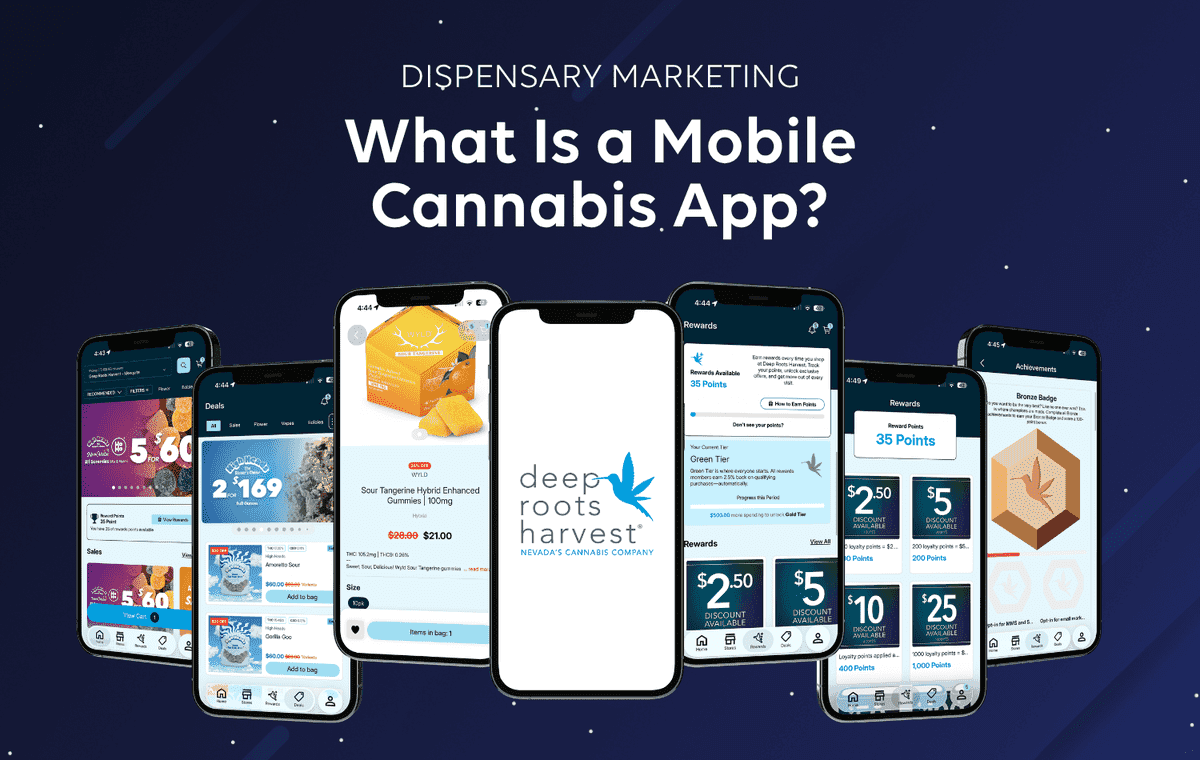
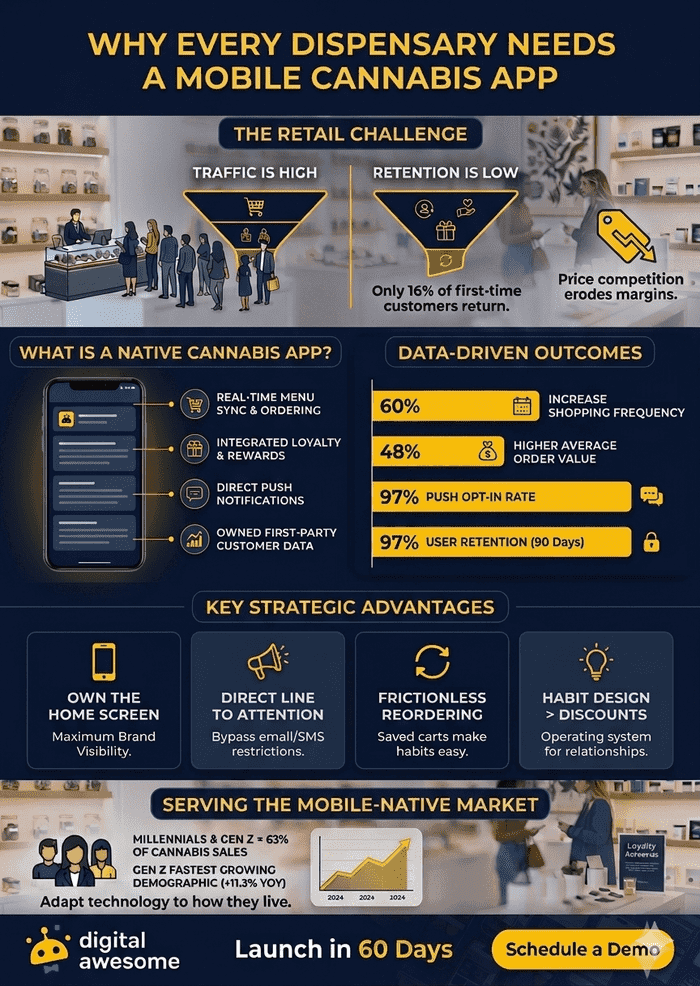
A cannabis mobile app is a fully branded, native iOS and Android application built for a dispensary and published under its own name on the App Store and Google Play. It puts ordering, loyalty rewards, push notifications, and personalized offers directly on a customer's smartphone — and unlike a third-party menu or shared marketplace, everything inside it belongs to the dispensary: the brand, the data, and the direct line to every customer.
What a cannabis mobile app includes:
- Real-time menu sync connected to your existing POS and e-commerce platform
- Native ordering and checkout with age verification and compliance built in
- Loyalty and rewards programs — points, tiers, exclusive member offers, and microcurrency
- Personalized push notifications delivered directly to a customer's lock screen
- Saved carts and reorder preferences for frictionless repeat purchases
- First-party customer data — purchase history, frequency, and behavior you own entirely
What dispensaries typically see after launching a mobile app:
- Up to 60% increase in shopping frequency compared to in-store and online channels
- 48% higher average order values versus in-store purchases
- Push notification opt-in rates as high as 97%, compared to a 68% ecommerce average
- Up to 97% user retention in the first 90 days after launch
- Up to 30% of total store revenue flowing through the app within 90 days
Time to launch: A fully native iOS and Android dispensary mobile app can go live in as few as 60 days with the right development partner — including brand customization, POS integration, testing, and a guided launch strategy.
Who builds it: Look for a cannabis-specialized mobile app development partner like Digital Awesome with proven POS integrations, app store approval experience, and compliance expertise built into the development process — not a general-purpose agency applying a generic ecommerce template to a regulated industry.
Key Takeaways
- Retention is the real battleground — not traffic. Most dispensaries already have a traffic problem they don't know they have: customers who visit once and never come back. Only 16% of first-time dispensary customers return to the same retailer. A cannabis mobile app is built specifically to fix that number.
- A customizable app and a platform add-on are not the same product. A menu tab inside Dutchie or Jane is a convenience feature. A branded, native dispensary mobile app is an owned customer relationship — your name, your data, your direct line. The outcomes are not comparable.
- The dominant cannabis buyers are mobile-native by default. Millennials and Gen Z account for 63% of all U.S. cannabis sales, and Gen Z is growing fastest. These consumers don't adapt to your technology — they choose the dispensary whose technology fits how they already live.
- Competing on price accelerates margin erosion, not loyalty. Headset data shows cannabis flower prices dropped as much as 44% in some markets. Discounting trains customers to wait for deals. A mobile app builds the kind of habitual experience where price is no longer the deciding factor.
- The home screen is the most valuable real estate in cannabis retail. When your app lives on a customer's phone, you're not competing for attention through search or social — you already have it. Push notifications with 97% opt-in rates mean your deals, drops, and offers get seen.
- A cannabis mobile app is an operating system for customer relationships — not a marketing channel. The dispensaries driving 30% of total store revenue through their app didn't get there with better promotions. They got there by designing an experience worth returning to.
- The window for competitive advantage is closing. Every month a competitor's app sits on your customers' home screens, it's building habits that are increasingly difficult to displace. The cost of waiting is not a delayed investment — it's compounding customer attrition.
What Does "Mobile Dispensary" Mean?
The term "mobile dispensary" gets used two ways in the cannabis industry. The first refers to a licensed mobile retail unit — a vehicle or delivery operation that brings cannabis products directly to consumers. The second, more widely used meaning in the digital context, is simpler: your dispensary, on a mobile device.
When your customers open your branded app, they're stepping into a mobile dispensary. Your full product catalog, your deals, your loyalty program, your ordering system — all of it accessible anywhere, any time, with a few taps. That's the mobile dispensary experience that Digital Awesome builds for 400+ cannabis operators across North America.
What Makes a Dispensary Mobile App Different From a Website?
A website waits to be found. An app lives on your customer's home screen. That difference sounds simple, but the behavioral impact is enormous.
A native mobile app for a cannabis dispensary enables direct push notification delivery — no email open rates, no SMS carrier restrictions. It enables personalized product recommendations based on purchase history. It creates loyalty loops that reward customers for coming back rather than shopping around. And critically, it gives dispensaries a direct, owned relationship with their best customers — one that no third-party platform can take away.
Consider the behavioral gap: the average cannabis consumer visits a dispensary just 8 times per year and splits purchases across 3 different retailers. A well-built mobile cannabis app exists to collapse that split — making your dispensary the default, the habit, the first tap.
Key Features of a Mobile App for Cannabis Dispensaries
The best dispensary mobile apps aren't just digital menus. They're retention engines built around how customers actually behave. The essential features include:
Real-Time Menus. Your inventory syncs automatically, so customers always see what's actually available. No more "sorry, that's out of stock" moments that kill trust and send shoppers elsewhere.
Native Ordering and Checkout. Seamless, compliant purchasing flows built for cannabis retail — no redirects, no friction, no abandoned carts. This includes choosing the right login method for your customers — something worth thinking through carefully before launch. Our breakdown of OTP vs. password authentication for dispensary apps walks through exactly what that decision affects.
Loyalty and Rewards Integration. Points, tiers, exclusive member offers, and gamified milestones that give customers a genuine reason to return — and to keep their streak alive.
Personalized Push Notifications. Direct-to-device messaging with opt-in rates as high as 97%, compared to an industry ecommerce average of 68%. When you have a new drop, a flash deal, or a "we miss you" offer, you can reach customers instantly — without fighting for inbox space.
Reorder and Saved Preferences. Frictionless repeat purchasing for your most loyal customers. One tap to reorder their usual. That's the kind of convenience that builds habits.
Real-Time Analytics. See which products are performing, when customers disengage, and where in the experience you're losing people — then act on it without waiting for a quarterly report.
POS and Tech Stack Integration. Digital Awesome apps integrate with the platforms dispensaries already rely on — Treez, Jane, AIQ, Flowhub, Dutchie, Meadow, and more. There's no need to blow up your existing setup to go mobile.
How Cannabis Mobile App Development Works
For many operators, "app development" conjures images of six-figure budgets, year-long timelines, and a tech team you don't have. The reality, with the right partner, looks nothing like that.
Cannabis mobile app development with Digital Awesome takes as little as 60 days from kickoff to App Store and Google Play launch. The process covers brand customization — your colors, your fonts, your voice — followed by integration setup with your existing POS and loyalty systems, quality testing across both platforms, and a guided launch strategy designed to drive immediate adoption.
One factor operators often overlook: local expertise in cannabis app development makes a meaningful difference in compliance handling, app store approval, and regional market nuances. Working with a team that understands your state's regulations — not just generic app development — shortens timelines and prevents costly rework. Operators focus on their dispensary. We handle every line of code.
"The dispensaries winning in this market aren't the ones with the most products or the lowest prices — they're the ones that have made coming back effortless. A cannabis mobile app isn't a marketing tool. It's an operating system for customer relationships. When your brand lives on someone's home screen, you're not competing for attention anymore — you're part of their routine. We've seen dispensaries go from 2% monthly repeat rates to driving 30% of their total store revenue through the app alone. That transformation doesn't happen through discounts. It happens through habit design."
— Digital Awesome Team, Cannabis Mobile App Development Specialists Insight drawn from working with 400+ cannabis operators across North America, analyzing retention data, app adoption benchmarks, and repeat purchase behavior across dispensary partners including operators in Ohio, California, and Michigan.
7 Essential Resources for Dispensary Owners
These are verified U.S. government sources that provide the research, data, and regulatory context every dispensary owner should understand before making decisions about mobile technology and the cannabis retail market.
1. CDC — Cannabis: Facts and Statistics The Centers for Disease Control and Prevention's authoritative data hub on cannabis use across the United States. Includes prevalence rates by age group, frequency of use data, and surveillance resources — essential context for understanding the scale and demographics of your potential customer base. The CDC confirms cannabis is the most commonly used federally illegal substance in the U.S., with 52.5 million Americans reporting use at least once in 2021. 🔗 https://www.cdc.gov/cannabis/data-research/facts-stats/index.html
2. SAMHSA — 2024 National Survey on Drug Use and Health (NSDUH) The Substance Abuse and Mental Health Services Administration's annual national survey is the most comprehensive source of cannabis consumption data in the country. The 2024 release reports that 44.3 million Americans (15.4% of people aged 12 or older) used marijuana in the past month — a significant increase from 37 million in 2021. That growing consumer base represents a direct market opportunity for dispensaries with the digital infrastructure to serve and retain them. 🔗 https://www.samhsa.gov/data/data-we-collect/nsduh-national-survey-drug-use-and-health/national-releases
3. NIDA — Cannabis and Hallucinogen Use Among Adults Remained at Historic Highs in 2023 The National Institute on Drug Abuse's findings from the Monitoring the Future study show that 42% of adults aged 19–30 reported past-year cannabis use in 2023 — an all-time high — and that both past-year and past-month use have trended upward for five and ten consecutive years. This is the core demographic dispensary mobile apps are built to serve: frequent, digitally native, habitual consumers. 🔗 https://nida.nih.gov/news-events/news-releases/2024/08/cannabis-and-hallucinogen-use-among-adults-remained-at-historic-highs-in-2023
4. U.S. Census Bureau — Quarterly Retail E-Commerce Sales Report The Census Bureau's official measurement of U.S. retail e-commerce sales — including mobile commerce (M-Commerce) — tracks how digital purchasing has reshaped every retail category. E-commerce accounted for 16.6% of total U.S. retail sales in Q4 2025, growing 5.3% year-over-year. Cannabis retail is operating inside this broader shift, and dispensaries without a direct digital ordering channel are surrendering a structurally growing share of consumer spending. 🔗 https://www.census.gov/retail/ecommerce.html
5. Bureau of Economic Analysis (BEA) — U.S. Digital Economy: New and Revised Estimates The BEA's digital economy report tracks how software, e-commerce, and digital services are outpacing the broader U.S. economy in value added and growth rate. In 2022, the digital economy grew at 6.3% — more than triple the 1.9% rate of overall GDP. Dispensaries investing in native mobile apps are investing in the fastest-growing segment of retail infrastructure, not a trend. 🔗 https://apps.bea.gov/scb/issues/2023/12-december/1223-digital-economy.htm
6. FTC — Marketing Your Mobile App: Get It Right from the Start The Federal Trade Commission's official guidance for businesses developing and launching mobile applications. Covers truth-in-advertising requirements, privacy disclosure standards, and the compliance obligations that apply to any app regardless of industry size. Every cannabis dispensary launching a mobile app should read this before going live to ensure their customer communications, push notification practices, and data handling meet federal standards. 🔗 https://www.ftc.gov/business-guidance/resources/marketing-your-mobile-app-get-it-right-start
7. FTC — App Developers: Start with Security The FTC's security guidance for app developers outlines the data protection and authentication practices required of businesses that collect customer information through mobile applications. For dispensaries collecting purchase history, loyalty data, and personal preferences through a cannabis mobile app, this guidance defines the baseline security obligations — including data minimization, encryption standards, and user consent — that directly impact customer trust and long-term retention. 🔗 https://www.ftc.gov/business-guidance/resources/app-developers-start-security
3 Statistics Every Dispensary Owner Should Know
Stat 1 — Your Customer Base Has Never Been Larger. Most Dispensaries Still Can't Retain It. According to the 2024 National Survey on Drug Use and Health released by the Substance Abuse and Mental Health Services Administration (SAMHSA), 44.3 million Americans — 15.4% of people aged 12 or older — used marijuana in the past month in 2024. That is an increase from 37 million in 2021, making it the highest monthly use figure ever recorded in the survey's history. This isn't a niche market anymore. It's a mainstream consumer category with a growing, habitual audience. The dispensaries that build a direct owned relationship with even a fraction of these consumers — through a branded mobile app — are positioned to capture a disproportionate share of that spending. The ones that don't are leaving their most valuable customers one tap away from a competitor who has. 🔗 Source: SAMHSA — 2024 National Survey on Drug Use and Health (NSDUH) https://www.samhsa.gov/data/data-we-collect/nsduh-national-survey-drug-use-and-health/national-releases
Stat 2 — The Customers Driving Cannabis Sales Are the Most App-Native Consumers on Earth. According to Headset's Cannabis Demographics Report — sourced directly from point-of-sale transaction data across thousands of US dispensaries — Millennials and Gen Z consumers together account for 63% of all cannabis sales in the United States. Gen Z is the fastest-growing segment, with their share of total cannabis sales growing 11.3% year-over-year. These are not consumers who will tolerate a clunky mobile website or a loyalty card they lose in their wallet. They grew up with apps. They shop with apps. They build habits through apps. A dispensary that hasn't built a mobile experience for these consumers isn't just behind on technology — it's misaligned with the purchasing behavior of the majority of its own market. 🔗 Source: Headset — Cannabis Demographics Report 2023 https://www.headset.io/industry-reports/demographics-report-2023
Stat 3 — Competing on Price Is Already a Losing Strategy. The Data Proves It. Headset's pricing compression analysis — drawn from real transaction data across California, Colorado, Michigan, and Ontario — found that average cannabis item prices declined steadily from late 2020 onward, with Michigan seeing a staggering 44% drop in average item price between October 2020 and October 2022 alone. Average discount rates rose in every market over the same period, as operators raced to attract customers through promotional pricing. The result: basket sizes fell by as much as 29% even as consumers kept buying the same number of products per trip — simply at lower and lower prices. Discounting does not build loyalty. It trains customers to wait for the deal. A cannabis mobile app builds the kind of habitual, frictionless experience that makes your dispensary the default choice before a customer even thinks to compare prices. 🔗 Source: Headset — Cannabis Flower: Examining Pricing Compression in the US & Canada https://www.headset.io/industry-reports/cannabis-flower-examining-pricing-compression-in-the-us-canada
Our Take
Here's our honest take: the dispensaries that are going to dominate the next five years of the legal cannabis market are not going to win on selection or price. Price compression is real — flower prices are falling, margins are tightening, and discounting your way to loyalty is a race to the bottom.
The operators who win will be the ones who own the relationship. And you cannot own a relationship you don't have direct access to.
A dispensary mobile app gives you that access. It gives you the home screen. It gives you the push notification. It gives you the purchase history, the personalized offer, and the loyalty loop that makes your dispensary the default choice — not just a convenient option on the day someone runs low.
We've watched this play out across 400+ dispensary partners. The results aren't marginal. A 30% app adoption rate in 90 days. A 48% higher average order value. A 97% user retention rate in the first three months. These aren't product features — they're outcomes of building the right kind of customer relationship at scale.
If you're still waiting to go mobile, you're not waiting for the right time. You're just giving your customers more time to build habits with someone else's app.
What's Next?
If this resonates, here's how to move forward without overcomplicating it:
Step 1 — Explore what a dispensary mobile app actually includes. Before you commit to anything, understand what you're building. Visit our dispensary apps page to see every feature, integration, and customization option in one place.
Step 2 — Calculate your potential ROI. We've built a free ROI calculator so you can estimate exactly what a Digital Awesome mobile app could add to your monthly and annual revenue based on your current customer data. Run Your ROI Calculation →
Step 3 — Schedule a demo. See the product live, ask every question you have, and find out what a 60-day launch looks like for your dispensary. No pressure, no hard sell — just a clear picture of what's possible. Schedule a Free Demo →
Work with an agency or tech partner? If you're a marketing agency, cannabis consultant, or software provider working with dispensary operators, our partner program lets you refer operators and earn upfront commission — with full support from our team on every deal.
Frequently Asked Questions
What is a cannabis mobile app? A cannabis mobile app is a branded native application for iOS and Android that allows a dispensary to offer real-time ordering, loyalty rewards, personalized push notifications, and seamless checkout directly on a customer's smartphone. Unlike a third-party platform, it is fully owned and customized by the dispensary. See everything it includes on our dispensary apps page.
What does "mobile dispensary" mean? In the digital context, a mobile dispensary refers to a dispensary's complete branded presence on a customer's mobile device. It puts your full store — menu, ordering, loyalty, and communications — on their home screen, making your dispensary the most convenient choice every single day.
How is a dispensary mobile app different from a website? A website waits to be searched for. A mobile app lives on the home screen, enables direct push notifications, stores customer preferences, and creates loyalty loops that a website cannot replicate. App users also spend 48% more per order on average than in-store shoppers.
How long does cannabis mobile app development take? With Digital Awesome, a fully native iOS and Android dispensary mobile app can go live in as little as 60 days — including brand customization, POS integration, testing, and a guided launch strategy.
Do I need a cannabis mobile app if I already have a website and loyalty program? Yes. A branded mobile cannabis app delivers significantly higher engagement and retention than a website alone — including 10.6x more weekly visits per user, up to 97% push notification opt-ins, and 60% higher shopping frequency compared to online and in-store channels.
What systems does a dispensary mobile app integrate with? Digital Awesome apps integrate with the cannabis tech stack operators already rely on, including Treez, Jane, AIQ, Flowhub, Dutchie, Meadow, and Onfleet — with zero lock-in. Switch providers any time without losing your app or your customer data.
AIQ, Flowhub, Dutchie, Meadow, and Onfleet — with zero lock-in. Switch providers any time without losing your app or your customer data.
How much does it cost to build a cannabis mobile app? Pricing varies based on features and scale. The best next step is scheduling a free demo to get a clear picture of costs, timelines, and expected ROI based on your dispensary's specific setup.
Ready to Put Your Dispensary on Every Customer's Home Screen?
You now know what a cannabis mobile app is, what it does, and what it can deliver. The only question left is whether your dispensary is going to build that relationship — or leave it for a competitor to own.
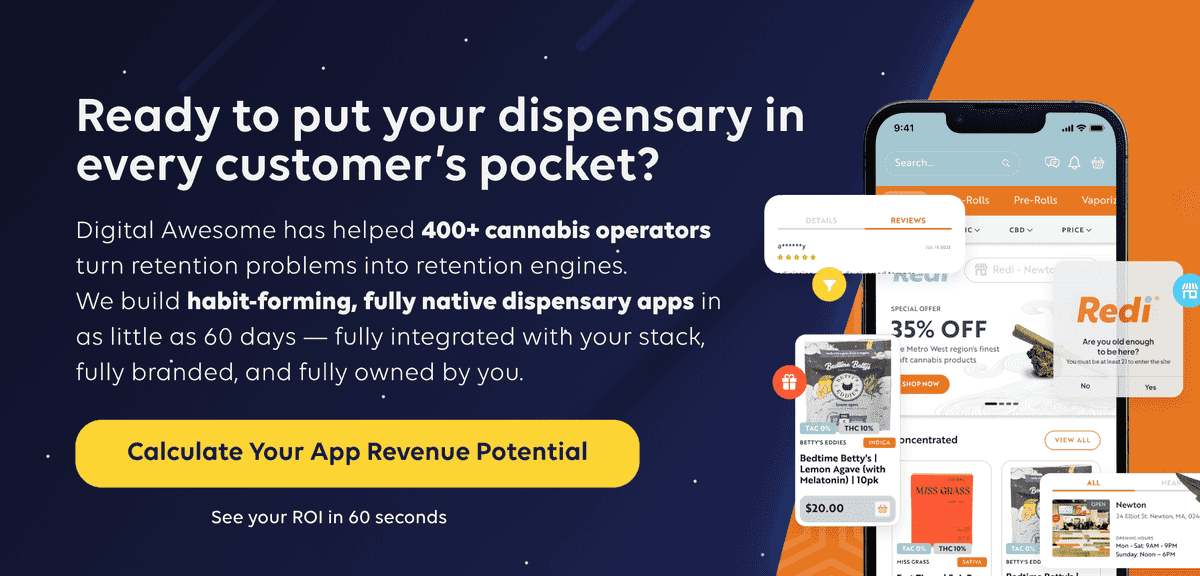
Digital Awesome has helped 400+ cannabis operators go from retention problem to retention engine. We build habit-forming, fully native dispensary mobile apps in as little as 60 days — fully integrated with your existing tech stack, fully branded to your dispensary, and fully owned by you.
Explore Our Dispensary Mobile App Features See every feature, integration, and customization option in one place.
Schedule a Free Demo Talk to our team, see the product live, and find out exactly what a 60-day launch looks like for your dispensary.
Become a Partner Agency, consultant, or software provider? Join our partner network and earn upfront commission on qualified referrals.
No commitment. No hard sell. Just a clear picture of what's possible.
Articles You May Like

Cannabis Marketing Agencies, Consultants, and Digital Marketing Experts: Digital Awesome's Trusted Partners
Your Customers Don't Stop Buying Cannabis.
Digital Awesome Becomes Alpine IQ's Premium Mobile App Offering for Cannabis Retailers