Cannabis App Development
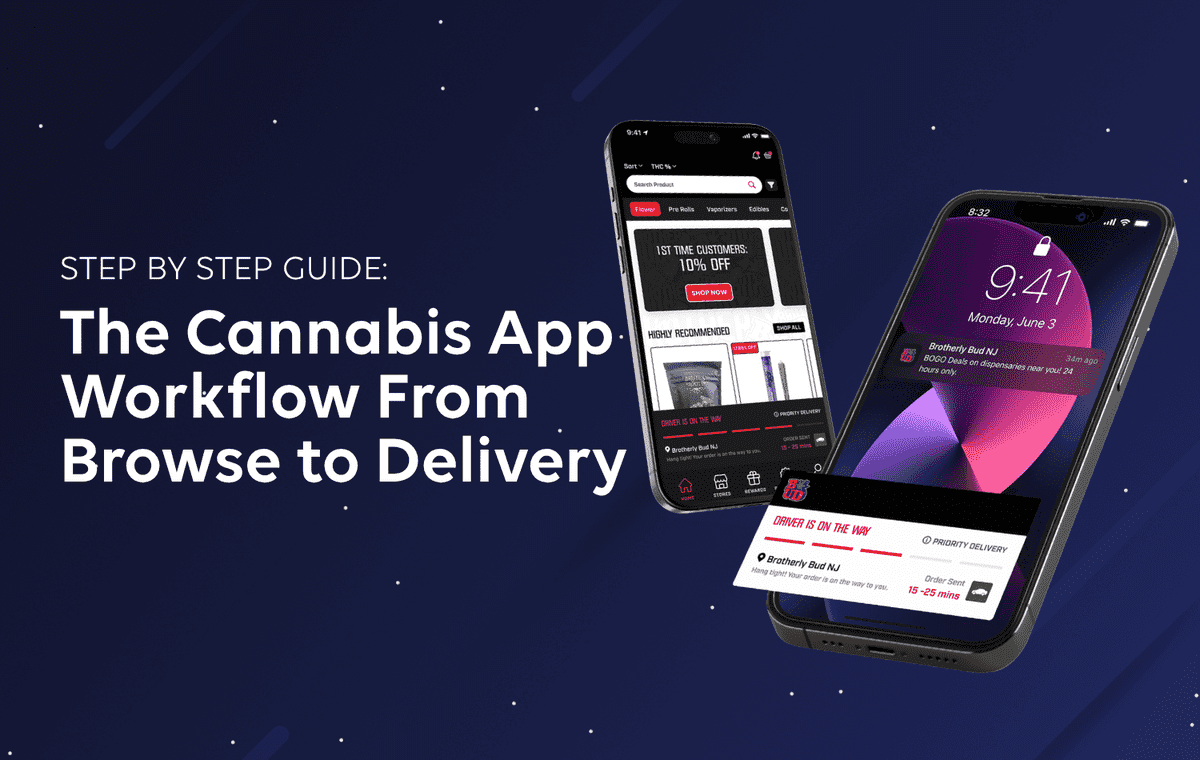
How Does a Dispensary App Work? A Step-by-Step Guide to the Cannabis App Workflow From Browse to Delivery
Posted by: Digital Awesome
April 06, 2026
A dispensary app is a mobile platform that allows cannabis consumers to browse a live product menu, place an order, and arrange pickup or delivery — all from their smartphone. Whether you're a first-time user researching what is a mobile cannabis app and how cannabis delivery apps work, or a dispensary operator looking to understand what powers these experiences, the process is more straightforward than most people expect.
At Digital Awesome, we've spent years building habit-forming cannabis mobile apps for dispensaries and brands across the United States and Canada. What we've learned is that the best dispensary apps don't just process transactions — they build loyalty, reduce friction, and keep customers coming back. This guide walks you through the full dispensary app process, from the moment you download it to the moment your order lands at your door.
Cannabis retail in the United States has undergone a significant shift in recent years. Cannabis dispensaries in the United States now operate openly across most of the country, and mobile ordering has become one of the primary ways consumers engage with them. Understanding how dispensary apps work isn't just useful for customers — it's essential knowledge for any operator who wants to stay competitive in today's mobile-first market.
TL;DR Quick Answers
How Does a Dispensary App Work?
A dispensary app works by connecting a customer's smartphone to a dispensary's live inventory, payment system, and fulfillment workflow in one seamless experience. From the moment a customer opens the app to the moment their order is fulfilled, every step is automated, compliant, and designed to reduce friction — making it easier to buy, and easier to come back.
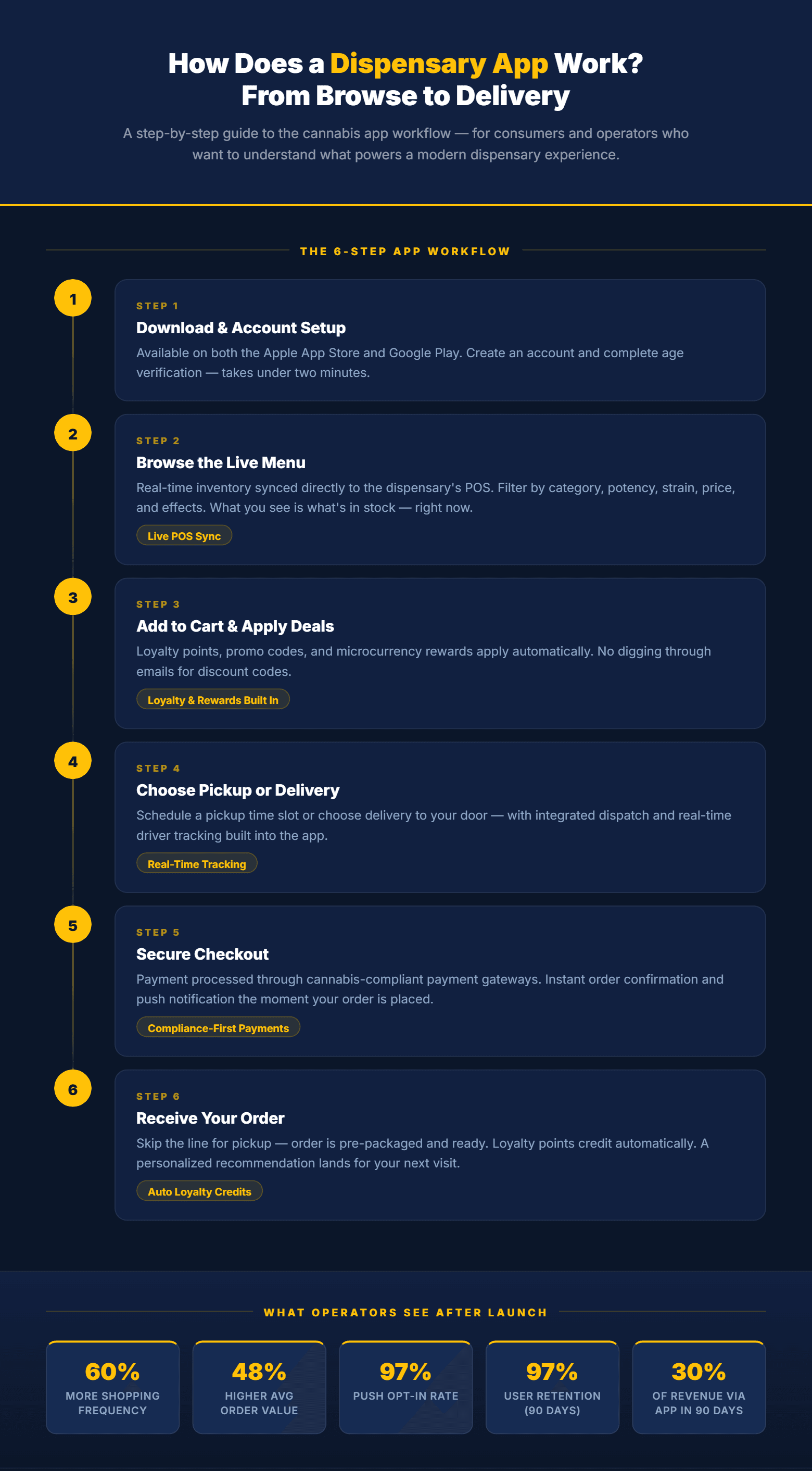
How the customer journey on a dispensary app process works, step by step:
- Customer downloads the app, creates an account, and completes age verification
- Live menu loads in real time, synced directly to the dispensary's POS system
- Customer filters by category, potency, strain, or price and adds items to cart
- Loyalty points, promo codes, or microcurrency rewards are applied at cart
- Customer selects pickup with a scheduled time slot or delivery to their door
- Payment is processed through a cannabis-compliant payment gateway
- Order confirmation and push notification are sent instantly
- For delivery, real-time driver tracking is available through the app
- Loyalty points are credited automatically once the order is fulfilled
What operators experience when the workflow runs properly:
- 60% increase in shopping frequency versus in-store and online channels
- 48% higher average order values compared to in-store purchases
- Up to 97% push notification opt-in rates versus a 68% eCommerce average
- 97% user retention in the first 90 days after launch
- Up to 30% of total store revenue processing through the app within 90 days
What makes it work behind the scenes: The app connects to the dispensary's existing POS, payment processor, loyalty platform, and last-mile delivery software — all running simultaneously so the customer only ever sees a smooth, fast ordering experience.
Who gets this right: Digital Awesome builds native iOS and Android dispensary apps for cannabis operators across the United States, with every integration, compliance layer, and retention mechanic built in from day one.
Key Takeaways
Here are the most important things to understand about how dispensary apps work:
- A dispensary app connects a consumer's phone directly to a dispensary's live inventory, enabling real-time browsing, ordering, and payment without a phone call or walk-in visit.
- The dispensary app process has six key stages: download and account setup → browse live menu → add to cart → choose pickup or delivery → secure checkout → receive your order.
- Cannabis delivery apps work through a network of integrations — POS systems, payment processors, loyalty platforms, and delivery dispatch tools all communicate with one another in the background.
- Mobile app ordering drives higher revenue per customer. Digital Awesome clients see 48% higher average order sizes through the app versus in-store, and 60% more frequent shopping behavior.
- Push notifications are a superpower for dispensaries — Digital Awesome-powered apps achieve up to 97% push notification opt-in rates, compared to the 68% eCommerce average.
- Online ordering now accounts for 25–30% of dispensary revenue according to Headset.io — and it's still growing.
- Compliance is built in. Every Digital Awesome dispensary app includes age verification, state-compliant payment processing, and delivery protocols aligned with applicable state law.
- The best dispensary apps are habit-forming by design, using loyalty rewards, personalized recommendations, and frictionless reordering to turn first-time buyers into long-term regulars.
How Does a Dispensary App Work?
The dispensary app process follows a clear, intuitive workflow. Here's what happens from start to finish:
Step 1 — Download and Account Setup Start by downloading the app from the Apple App Store or Google Play — Android app development for cannabis retail has matured to the point where the experience is just as seamless and intuitive on any device.
Step 2 — Browse the Live Menu Once inside, you're presented with a real-time product menu synced directly with the dispensary's point-of-sale (POS) system. Products are organized by category — flower, edibles, concentrates, tinctures, and more — and filtered by price, potency, strain type, and effects. What you see is what's actually in stock, updated in real time.
Step 3 — Add to Cart and Apply Deals Select your products, choose your quantities, and add them to your cart. Loyalty points, promo codes, and any available dispensary deals are applied automatically or with a simple tap. Apps built by Digital Awesome also support microcurrency — a branded rewards layer that incentivizes repeat purchases and keeps customers engaged between visits.
Step 4 — Choose Pickup or Delivery At checkout, you select whether you'd like to pick up in-store at a scheduled time slot or have your order delivered to your door. Delivery is powered by integrated dispatch tools, providing real-time driver tracking and estimated arrival times.
Step 5 — Secure Checkout Payment is processed through cannabis-compliant payment solutions, or cash on delivery. You'll receive an order confirmation and push notification the moment your order is placed.
Step 6 — Receive Your Order For pickup, simply walk in and skip the line — your order is pre-packaged and ready. For delivery, track your driver in real time. After your order is fulfilled, loyalty points are credited to your account and you may receive a satisfaction prompt or personalized product recommendation for your next visit.
That's the full cannabis app workflow in action — intuitive, fast, and designed to make every step feel effortless.
"Most dispensaries think they have a traffic problem. What they actually have is a retention problem. A well-built dispensary mobile app isn't a digital menu — it's a relationship engine. When a customer can reorder their favorite product in two taps, earn points without thinking about it, and get a push notification that actually feels relevant rather than spammy, you've built something powerful. We've seen dispensaries go from struggling to retain customers past the first purchase to achieving 97% retention in the first 90 days simply by giving those customers a reason to keep coming back through a native mobile experience. The cannabis app workflow isn't complicated — but getting it right, from the POS integration to the checkout experience to the loyalty layer, requires deep industry expertise. That's what Digital Awesome brings to the table."
— Digital Awesome A Leading Cannabis Mobile App Developer
7 Essential Resources for Cannabis and Dispensaries
Understanding how cannabis delivery apps operate means understanding the regulatory landscape they exist within. Here are seven verified U.S. government resources every dispensary operator and consumer should know:
- CDC — Cannabis Facts and Stats The Centers for Disease Control and Prevention maintains a comprehensive data hub on cannabis use prevalence across the United States, including behavioral trends, usage patterns by demographic, and public health surveillance data. 🔗 https://www.cdc.gov/cannabis/data-research/facts-stats/index.html
- CDC — State Medical Cannabis Laws An up-to-date overview of which states have enacted medical and adult-use cannabis programs, how those programs differ, and what types of cannabis products are permitted under each state's regulatory framework. 🔗 https://www.cdc.gov/cannabis/about/state-medical-cannabis-laws.html
- SAMHSA — Marijuana Data and Research The Substance Abuse and Mental Health Services Administration publishes national data on cannabis use prevalence, treatment trends, and policy implications — an essential resource for understanding the scale of the market dispensary apps serve. 🔗 https://www.samhsa.gov/data/taxonomy/term/435
- NIDA — Scope of Marijuana Use in the United States The National Institute on Drug Abuse provides research-backed data on cannabis use in the U.S., offering context for the scale of the consumer base that dispensary mobile apps are designed to serve. 🔗 https://nida.nih.gov/research-topics/cannabis-marijuana
- Congress.gov — The Federal Status of Marijuana and the Policy Gap with States A Congressional Research Service brief that explains the ongoing divergence between federal cannabis law and state legalization, and what that means for businesses operating licensed dispensaries and cannabis delivery apps. 🔗 https://www.congress.gov/crs-product/IF12270
- Data.gov — Cannabis Datasets The U.S. Government's open data hub includes multiple cannabis-related datasets covering retail sales, pricing, and product market data from states with legal markets — invaluable for operators building data-driven dispensary app strategies. 🔗 https://catalog.data.gov/dataset?tags=marijuana
- NIH/PMC — U.S. State Recreational and Medical Cannabis Delivery Laws, 2024 A peer-reviewed legal epidemiology study published on the National Institutes of Health platform that maps which states permit direct cannabis delivery, the licensing requirements, and age verification obligations — directly relevant to how cannabis delivery apps must be built to comply. 🔗 https://pmc.ncbi.nlm.nih.gov/articles/PMC11715591/
3 Statistics That Define the Dispensary App Market
Statistic 1 — Cannabis Consumers Are Everywhere
According to data cited by the Congressional Research Service, an estimated 64.2 million individuals aged 12 or older used marijuana in the past year in 2024, with 44.3 million reporting use in the past month. That represents a dramatic increase from 6.1% of the population in 2008 to 15.4% in 2024 — a consumer base that is enormous, growing, and increasingly mobile-first. 🔗 Source: Congress.gov — Federal Status of Marijuana
Statistic 2 — Online Orders Now Drive 25–30% of Dispensary Revenue
According to cannabis data leader Headset.io, online ordering now accounts for 25–30% of dispensary sales revenue — and that share is still climbing. Headset, which directly measures over $1 billion in cannabis transactions monthly across more than 3,500 retail partners in the U.S. and Canada, tracks this shift in real time. Dispensaries without a strong mobile ordering experience are already leaving a significant portion of their revenue on the table. 🔗 Source: Headset.io — Cannabis Retail Intelligence
Statistic 3 — 14 States Now Allow Recreational Cannabis Delivery
A 2024 legal review published via the National Institutes of Health found that 14 states have authorized the direct delivery of recreational cannabis to adults, and 26 states plus the District of Columbia permit the direct delivery of medical cannabis. This rapid policy expansion is a key driver of why cannabis delivery apps have become a strategic necessity rather than a nice-to-have for dispensary operators. 🔗 Source: PMC/NIH — US State Cannabis Delivery Laws 2024
Our Take
The dispensary app market is no longer in its experimental phase — it's maturing fast, and operators who treat their mobile app as an afterthought are being left behind by those who treat it as a core business asset.
What stands out to us at Digital Awesome, after working with 400+ cannabis operators across the country, is that the most successful dispensary apps share one thing in common: they're built around the customer's behavior, not just the operator's inventory. They don't just list products. They anticipate preferences, reward loyalty automatically, and make reordering feel as natural as checking the weather.
The cannabis app workflow, when executed well, creates a habit. And habits are what drive retention. A customer who places an order through your app once is a transaction. A customer who does it every week because your app makes it easier than any alternative — that's a relationship. That's the difference between an average dispensary experience and a Digital Awesome-built one.
Our honest take: if you're a dispensary operator and you don't have a native mobile app, you're not just missing out on convenience — you're missing out on the single most effective channel for customer retention that cannabis retail has ever had.
What's Next?
Whether you're a consumer learning how dispensary apps work or an operator evaluating mobile app development partners, here's what to do next:
If you're a cannabis consumer:
- Download your local dispensary's app from the App Store or Google Play
- Create your account, verify your age, and explore the live menu
- Enable push notifications to unlock exclusive deals and loyalty rewards
- Try placing your first order — pickup is a great starting point for new users
If you're a dispensary operator:
- Explore what a Digital Awesome-built dispensary app can do for your business: Digital Awesome Dispensary Apps →
- Use the Digital Awesome ROI Calculator to estimate your potential revenue uplift: Calculate Your ROI →
- Review the Ohio case study to see how one dispensary achieved 30% app adoption in 90 days: Read the Amplify Case Study →
- Schedule a no-pressure demo to see the platform in action: Book a Demo →
Frequently Asked Questions
How does a dispensary app work?
A dispensary app allows cannabis consumers to browse a real-time product menu, select items, and place an order for pickup or delivery from their smartphone. The app connects directly to the dispensary's point-of-sale system to reflect live inventory and pricing. Digital Awesome builds these native apps for iOS and Android, integrating loyalty, payments, and delivery into a single seamless experience.
How does a dispensary mobile app work differently from a website?
A dispensary mobile app provides a fundamentally different experience from a website. It supports push notifications (with up to 97% opt-in rates in Digital Awesome apps), saved product preferences, one-tap reordering, and loyalty rewards — all of which drive significantly higher engagement and retention than a browser-based experience. Digital Awesome clients see 10.6x more weekly visits per user through their app versus other channels.
What is the dispensary app process from start to finish?
The full dispensary app process involves: (1) downloading the app and verifying your age, (2) browsing the live menu filtered by your preferences, (3) adding products to your cart and applying loyalty rewards or promo codes, (4) selecting pickup or delivery, (5) completing a secure checkout via a cannabis-compliant payment method, and (6) receiving your order — with loyalty points credited automatically upon fulfillment.
How do cannabis delivery apps work behind the scenes?
Cannabis delivery apps work by integrating several backend systems: the dispensary's POS manages inventory; a payment processor handles transactions; and a delivery dispatch platform manages driver assignment and real-time tracking. Digital Awesome connects all of these systems through a single native app experience, so the customer never sees the complexity — just a smooth ordering flow.
How do I order from a dispensary app for the first time?
Download the app, create a secure account with age verification, browse the live product menu, add your selections to cart, choose pickup or delivery, and complete checkout using a supported payment method. Most apps guide you through each step clearly. For first-time users, in-store pickup is often the simplest starting point, as it allows you to ask questions at the counter while still enjoying the convenience of pre-ordering.
Is it safe to order cannabis through a mobile app?
Yes. Licensed dispensary apps built by companies like Digital Awesome comply with state regulations, require age verification at account creation and delivery, and use secure, cannabis-compliant payment processors to protect transaction data. Every layer of the workflow — from login to checkout to delivery confirmation — is designed with compliance and security in mind.
Which dispensaries use Digital Awesome apps?
Digital Awesome's platform is used by 400+ cannabis operators across the United States, including Cookies, Planet 13, Glass House Brands, Sol Flower, Exclusive, and many more. Apps are built for iOS and Android and can go live in as few as 60 days.
Ready to See How a Digital Awesome Dispensary App Can Transform Your Business?
If you're a dispensary operator and this guide has made one thing clear, it's this: mobile is where your customers are, and a purpose-built native app is how you meet them there. Digital Awesome has helped 400+ cannabis operators turn mobile into their most powerful retention and revenue channel — and we can do the same for you.
👉 Explore Digital Awesome Dispensary Apps See the platform, explore features, and understand what's possible for your dispensary.
👉 Schedule a Demo Talk to our team. No pressure, no sales pitch — just a real conversation about what's right for your dispensary.