Cannabis App Development
What Actually Makes the Best Cannabis POS, Not Just a Compliant One
Posted by: Digital Awesome
October 02, 2026
Plenty of point of sale systems can technically ring up a cannabis sale. Far fewer are actually built for one. The difference matters more than it looks on a sales call, because the features that make a POS "compliant" (a plugin here, a workaround there) are not the same as features that make it built for cannabis from the ground up.
This guide breaks down where generic retail POS systems fall short for dispensaries, what the best cannabis POS systems handle natively that a bolted-on retail system does not, and what the full tech stack around your POS, not just the software itself, actually needs to include. If you're still narrowing down which cannabis-specific provider to pick, our full POS buyer's guide covers that side of the decision.
TL;DR Quick Answers
- Can a generic retail POS work for a dispensary? Technically, with enough third-party add-ons. The question is whether you want compliance features bolted on or built in.
- What does a cannabis-built POS handle that a generic one doesn't? Seed-to-sale tracking integration, state-specific purchase limit enforcement, and in several states, mandatory electronic ID scanning at the point of sale.
- Is "best cannabis pos" really about the software alone? No. The best setups pair POS software with the right hardware, loyalty integration, and delivery tooling, not just the checkout screen.
Top Takeaways
Cannabis Retail POS vs. Generic Retail Systems: Where They Actually Diverge
A generic retail POS is built to ring up SKUs and process payment. A cannabis-built POS has to additionally handle three things most retail software was never designed for:
- Seed-to-sale tracking integration, syncing every sale with your state's required tracking system (Metrc, BioTrack, or similar), not as an afterthought but as a core function
- State-specific purchase limit enforcement, automatically calculating and blocking sales that exceed daily or per-transaction THC and weight limits, which vary by state and by product type
- Mandatory ID scanning, in several states this is not optional. Illinois law requires dispensaries to use an electronic reader or scanning device to verify a purchaser's government-issued identification before any sale, not just a visual check
None of this is exotic. It is the baseline a cannabis-built POS starts with, and the baseline a generic retail system has to be retrofitted to reach.
The Best Tech for Cannabis Retail POS Goes Beyond the Software Itself
The POS software is the center of the system, not the whole system. A complete cannabis retail tech stack typically also includes:
- Loyalty and rewards integration (Alpine IQ, Springbig, Birchmount, or similar), since purchase and loyalty data rarely live in the same place by default
- Payment processing built for cannabis (Aeropay, CanPay, TreezPay), since many standard card processors still won't touch cannabis transactions
- Delivery and logistics tooling (Onfleet or similar), if delivery is part of the business
- A mobile app layer that works independently of whichever POS is chosen, so switching POS providers later doesn't mean rebuilding the customer-facing experience from scratch, see what a complete mobile app layer actually includes for the full breakdown. In practice, this is what separates a fast checkout from a slow one: fast re-logins through one-time passcodes instead of retyping a password, fast product discovery through filters and deals pages, and a friction-free path from browsing to paid order. Redi, a Massachusetts dispensary, specifically improved search speed and checkout time this way, on top of broader engagement gains.
Digital Awesome's own full app feature set and full list of supported integrations are built around exactly this stack, not just the POS connection alone. One concrete example of what that looks like in practice: store data auto-populates from the POS on a nightly sync, so inventory and store details stay current in the app without someone manually re-entering anything every time the POS updates. The POS data itself has a second life beyond running the register, Cannabis Creative Group has a good breakdown on turning POS data into a digital advertising strategy, worth a look if marketing is the next piece of the stack you're solving for.
Getting the app right matters just as much as getting the POS right. One Ohio dispensary saw customers shop 3.4 times more often after launching a properly built app, with average spend climbing from $67 to $99, a result tied to the app itself, which is exactly the point: the POS decision and the app decision are separate, and getting both right is what shows up in numbers like these.
Expert's Quote
"The mistake we see most often is dispensaries treating compliance features as something they'll 'figure out later' with a generic POS. By the time they realize seed-to-sale tracking or purchase limit enforcement needs a workaround, they've already built processes around a system that was never designed for it. Starting with software built for cannabis from day one isn't a nice-to-have, it's the difference between compliance being automatic and compliance being something a budtender has to manually double-check on every sale."
— Digital Awesome
What This Means for Choosing Your Cannabis Dispensary POS System
The honest answer to "what's the best cannabis POS" isn't a single provider name, it's a checklist. Does the system handle seed-to-sale tracking natively, or does it need a third-party bridge? Does it calculate purchase limits automatically, or does a budtender have to do that math manually at checkout? If your state mandates ID scanning, does the POS integrate with an approved scanner out of the box?
A generic retail POS can usually be made to do all of this. The real question is whether you want to pay for that retrofit yourself, in setup time, integration costs, and compliance risk during the gap, or start with software that was built around these requirements from day one.
This is also where the tech stack question matters as much as the POS choice itself. A POS that handles compliance well but doesn't integrate cleanly with your loyalty program, payment processor, or customer-facing app creates the same fragmentation problem in a different place. Digital Awesome's dispensary app is built to work independently of whichever POS a dispensary runs, Treez, Dutchie, Jane, Flowhub, Meadow, or POSaBit, so the POS decision and the customer experience decision don't have to be solved by the same vendor.
Next Steps
Whichever POS you're evaluating, run it against the three-part test in Section 3: native seed-to-sale integration, automatic purchase limit enforcement, and ID scanning compatibility if your state requires it. If a provider needs a workaround for any of these, that's not necessarily disqualifying, but it is a cost and a risk worth pricing in before you sign.
If your current or preferred POS provider isn't one Digital Awesome already lists as a supported integration, that's not a dead end either. Digital Awesome is built to be integration-ready: if your provider isn't on the current list, the question becomes how quickly a new connection can be built, not whether the app has to be rebuilt around a different POS entirely.
Frequently Asked Questions
Can I use a generic retail POS for my dispensary?
Technically yes, with enough third-party integrations for seed-to-sale tracking, purchase limits, and ID verification where required. Whether that's worth it compared to a cannabis-built system depends on your state's specific compliance burden and your tolerance for managing multiple vendors.
Is ID scanning required at every dispensary?
It depends on your state. Nevada and Illinois mandate electronic ID scanning by law. Many other states require age verification but allow visual ID inspection, check your specific state's regulations before assuming either way.
Does switching to a cannabis-built POS mean losing my current app or loyalty program?
Not if your app and loyalty integrations are built to work independently of your POS provider. That separation is exactly what avoids a full rebuild when you switch.
What's the difference between "cannabis retail pos" and a regular retail POS?
A cannabis retail POS is purpose-built around state cannabis compliance requirements, seed-to-sale tracking, purchase limits, and in some states, ID scanning, as core functions rather than add-ons.
Do I need different POS hardware for a cannabis-built system versus a generic one?
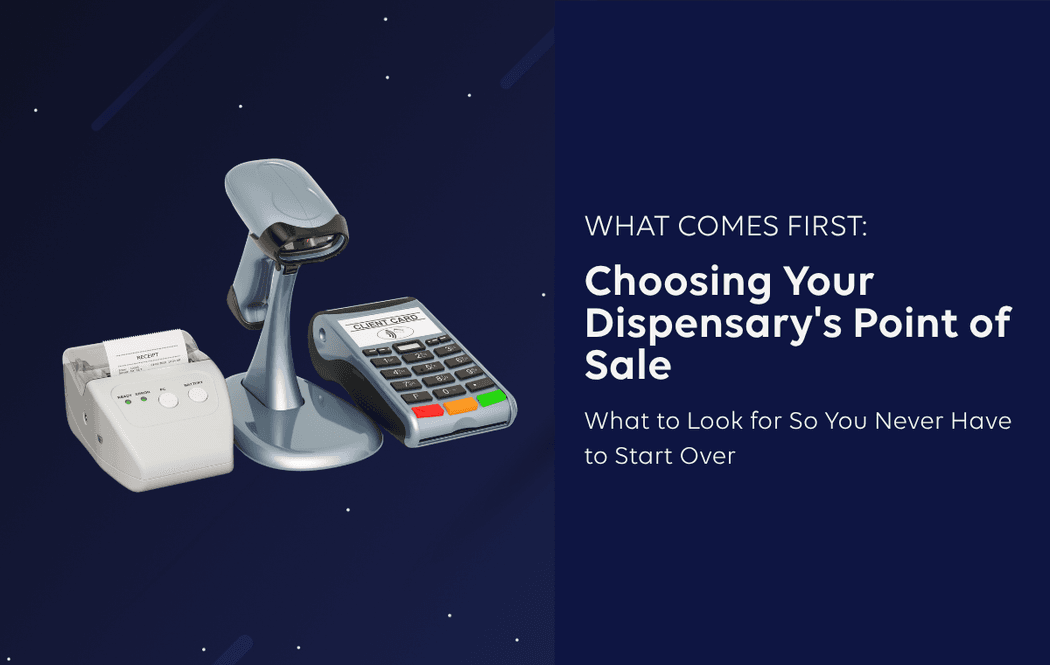
Not necessarily. Most cannabis-built POS systems work with standard card readers, receipt printers, and barcode scanners. The difference is in the software's compliance logic, not the physical hardware.
How do I know if a POS provider's compliance features are actually built in versus bolted on?
Ask directly whether seed-to-sale tracking, purchase limit calculation, and ID scanning integration (if required in your state) are native features or require a separate third-party add-on. The answer affects both cost and reliability.
Does any of this apply to cannabis brands, not just dispensaries?
The compliance requirements covered here are specific to retail dispensaries operating a POS. Cannabis product brands have a different set of considerations, for that side of the business, Digital Awesome's Brand Apps are built for brands rather than retail locations.
6 Essential Resources
The requirements below are not generic retail suggestions, they are state-mandated rules that a cannabis-built POS needs to satisfy, and that a generic retail system has to be specifically modified to meet.
- Nevada Age Verification & Acceptable Identification Requirements — Nevada Cannabis Compliance Board, mandates approved ID scanners at the point of sale under NCCR 7.015, 7.020, 15.015, and 15.020.
- Illinois Administrative Code, Section 1291.301: Minors Prohibited in Dispensary — Illinois General Assembly, requires electronic ID scanning at dispensaries, not visual inspection alone.
- Ohio Division of Cannabis Control: Non-Medical Sales Limits Guidance — Ohio DCC, ties purchase limit enforcement directly to point-of-sale configuration.
- New Jersey Cannabis Regulatory Commission: Licensed Dispensary Compliance Highlights — New Jersey CRC, THC packaging limits and compliance markers dispensaries must track at point of sale.
- Colorado Seed-to-Sale Tracking System Presentation — Colorado Department of Revenue, mandatory tracking under C.R.S. 44-10-202.
- Georgia Seed-to-Sale Tracking Rules, Chapter 351-5 — Georgia Secretary of State, requires tracking vendors to integrate "dispensing point-of-sale data" directly via API, one of the clearest regulatory ties between POS systems and compliance tracking of any source checked for this post.
3 Statistics
These numbers aren't just industry trivia, they're a reminder of how much state cannabis markets have come to depend on POS systems doing their compliance job correctly, since a single system failure or workaround touches real sales volume and real enforcement risk.
- New Jersey's regulated cannabis industry generated more than $1.16 billion in sales and $67.5 million in sales tax in 2025, all transacted through POS systems built to track THC limits per package. Source: New Jersey Cannabis Regulatory Commission.
- Illinois dispensaries are legally required to use an electronic reader or scanning device to verify every purchaser's ID before a sale, under 68 Ill. Adm. Code 1291.301, a requirement no out-of-box retail POS satisfies without integration. Source: Illinois General Assembly.
- Colorado's regulated cannabis industry, valued at $2 billion, operates under a state law mandate (C.R.S. 44-10-202(1)(a)) requiring seed-to-sale tracking for every licensed business, the same baseline requirement underlying both purchase-limit and ID-verification compliance. Source: Colorado Department of Revenue.
Ready to See a POS and App Built for Cannabis, Not Retrofitted For It?
You now know what separates a cannabis-built POS from a generic retail system wearing a compliance patch: native seed-to-sale tracking, automatic purchase limit enforcement, and ID scanning compatibility where your state requires it. The remaining question is whether your customer-facing app is built with the same independence, so a POS decision never forces an app rebuild.
Full feature and integration list → See every POS we support, every feature included, and exactly how the app works with your setup.
Live app demo → See the product in action, ask about your specific POS, and walk away with a clear picture of what launch looks like for your dispensary.
Calculate your ROI → See the real numbers for your store before you commit to anything.
No commitment. No hard sell. Just clarity.